
About Chinese measure words
Chinese Measure Words: Essential Classifiers and How to Use Them
You are in a Shanghai café and want one coffee. If you say 我要一咖啡 Wǒ yào yī kāfēi, the missing word between “one” and “coffee” makes the order sound incomplete. The natural request is 我要一杯咖啡 Wǒ yào yì bēi kāfēi: “I’d like one cup of coffee.”
That extra word, 杯 bēi, is a measure word. Once you understand what these words classify—and learn a small, useful core—measure words in Chinese become a logical system rather than a memorization burden.
Chinese measure words, also called Chinese classifiers, are words placed between a number or demonstrative and a noun: Number + Measure Word + Noun. Mandarin normally says 两本书 liǎng běn shū, literally “two-volume-books,” rather than putting “two” directly before “books.” There is no single universally agreed total, but practical lists may contain around 187; beginners can communicate widely by mastering a small core, while roughly 100 provides broad everyday coverage.
What are Chinese measure words, and why does Mandarin use them?
A Chinese measure word is a grammatical counting unit that links a quantity to a noun. English uses similar units mainly with mass nouns: a bottle of water, a drop of water, or a cup of water. Mandarin extends this kind of structure to ordinary countable nouns as well, so a person, a book, a cat, and a shirt normally each need an appropriate classifier when counted.
The English mass-noun comparison is a useful learning model, not a claim that every Chinese noun is linguistically identical to “water.” It helps explain the central idea: Mandarin does not usually combine a bare number directly with a noun. The classifier supplies the unit and often signals something about the noun’s type, shape, function, grouping, or container.
That added information is why classifiers often feel logical. Compare 一瓶水 yì píng shuǐ (one bottle of water), 两滴水 liǎng dī shuǐ (two drops of water), and 三杯水 sān bēi shuǐ (three cups of water). The noun 水 shuǐ stays the same; 瓶 píng, 滴 dī, and 杯 identify the counted units.
Classifiers can also categorize countable objects. 本 běn points toward bound reading material, while 张 zhāng commonly identifies a flat object. These clues help listeners anticipate the kind of noun that follows. Mandarin also generally leaves nouns unchanged for singular and plural; see GoEast’s guide to plurals in Chinese for the wider number system.
How is a Chinese counting phrase structured?
The core formula is Number + Measure Word + Noun. For example, 三个学生 sān gè xuésheng means “three students”: 三 is the number, 个 gè is the classifier, and 学生 xuésheng is the noun.
| Function | Pattern | Example | Meaning |
|---|---|---|---|
| Count a noun | Number + MW + Noun | 三杯咖啡 sān bēi kāfēi | three cups of coffee |
| Point out a noun | Demonstrative + MW + Noun | 这本书 zhè běn shū | this book |
| Ask a small quantity | 几 + MW + Noun | 几个人 jǐ gè rén | how many people? |
| Ask any quantity | 多少 + MW + Noun | 多少件衣服 duōshao jiàn yīfu | how many items of clothing? |
The same classifier slot follows demonstratives such as 这 zhè (this) and 那 nà (that), and question words such as 几 jǐ (how many, usually for a small expected number). In natural speech, the number “two” before a classifier is normally 两 liǎng, not 二 èr: say 两本书, not 二本书. Review the distinction in GoEast’s guide to numbers in Chinese.
Why does 一 change from yī to yí or yì?
The dictionary tone of 一 yī is first tone, but its spoken tone changes before many syllables. Before a fourth-tone syllable, it is normally pronounced yí, as in 一个人 yí gè rén. Before a first-, second-, or third-tone syllable, it is normally pronounced yì, as in 一杯咖啡, 一家餐厅 yì jiā cāntīng, and 一本杂志 yì běn zázhì. Pinyin in dictionaries may still show yī, but the changed pronunciation is what you will hear in connected speech.
Worked example. To build “I bought two books,” start with the number 两, choose 本 because the noun is bound reading material, add 书 shū, then place the phrase after 我买了 wǒ mǎi le.
Result: 我买了两本书 Wǒ mǎi le liǎng běn shū — the classifier 本 connects the quantity 两 to the noun 书.
Which five measure words should beginners learn first?
Start with 个, 杯, 本, 家 jiā, and 件 jiàn. Together, these five cover people and general objects, drinks, books, businesses, clothing, and matters—situations that appear constantly in beginner conversations.
General · 个 gè
People and general objects
Use 个 with many people, fruits, everyday objects, and abstract items: 两个朋友 liǎng gè péngyou (two friends), 一个苹果 yí gè píngguǒ (an apple), or 三个问题 sān gè wèntí (three questions).
Containers · 杯 bēi
Cups and glasses of drinks
Use 杯 when the serving unit is a cup or glass: 一杯茶 yì bēi chá (a cup of tea), 一杯水, or 一杯咖啡. The word specifies the drink’s container rather than its substance.
Bound material · 本 běn
Books, notebooks, magazines
Use 本 for bound material with pages: 一本书, 两本杂志 liǎng běn zázhì (two magazines), or 三本本子 sān běn běnzi (three notebooks).
Establishments · 家 jiā
Businesses and organizations
Use 家 for an organization operating as a unit: 一家餐厅, 一家公司 yì jiā gōngsī (a company), or 三家商店 sān jiā shāngdiàn (three shops).
Items · 件 jiàn
Clothing and matters
Use 件 for an item of clothing or a matter: 一件衣服 yí jiàn yīfu (an item of clothing) and 两件事情 liǎng jiàn shìqing (two matters). More specific classifiers are used for trousers, skirts, and some accessories.
How do Chinese classifiers form logical categories?
Useful classifiers are easier to remember by category than as one long alphabetical list. A classifier may highlight a container, physical shape, living category, function, or conventional grouping. The connection is not always predictable, but recognizing the pattern gives you a strong memory cue.
| Category | Classifier | Typical use | Example |
|---|---|---|---|
| Container | 碗 wǎn | bowls of food | 一碗饭 yì wǎn fàn — a bowl of rice |
| Container | 盒 hé | boxes | 一盒巧克力 yì hé qiǎokèlì — a box of chocolates |
| Flat shape | 张 zhāng | paper, tickets, tables | 一张票 yì zhāng piào — one ticket |
| Long shape | 条 tiáo | rivers, fish, trousers | 一条鱼 yì tiáo yú — one fish |
| Animals | 只 zhī | many animals and one of a pair | 一只猫 yì zhī māo — one cat |
| Vehicles | 辆 liàng | wheeled road vehicles | 一辆车 yí liàng chē — one vehicle |
| Respectful people | 位 wèi | people in polite contexts | 一位老师 yí wèi lǎoshī — one teacher |
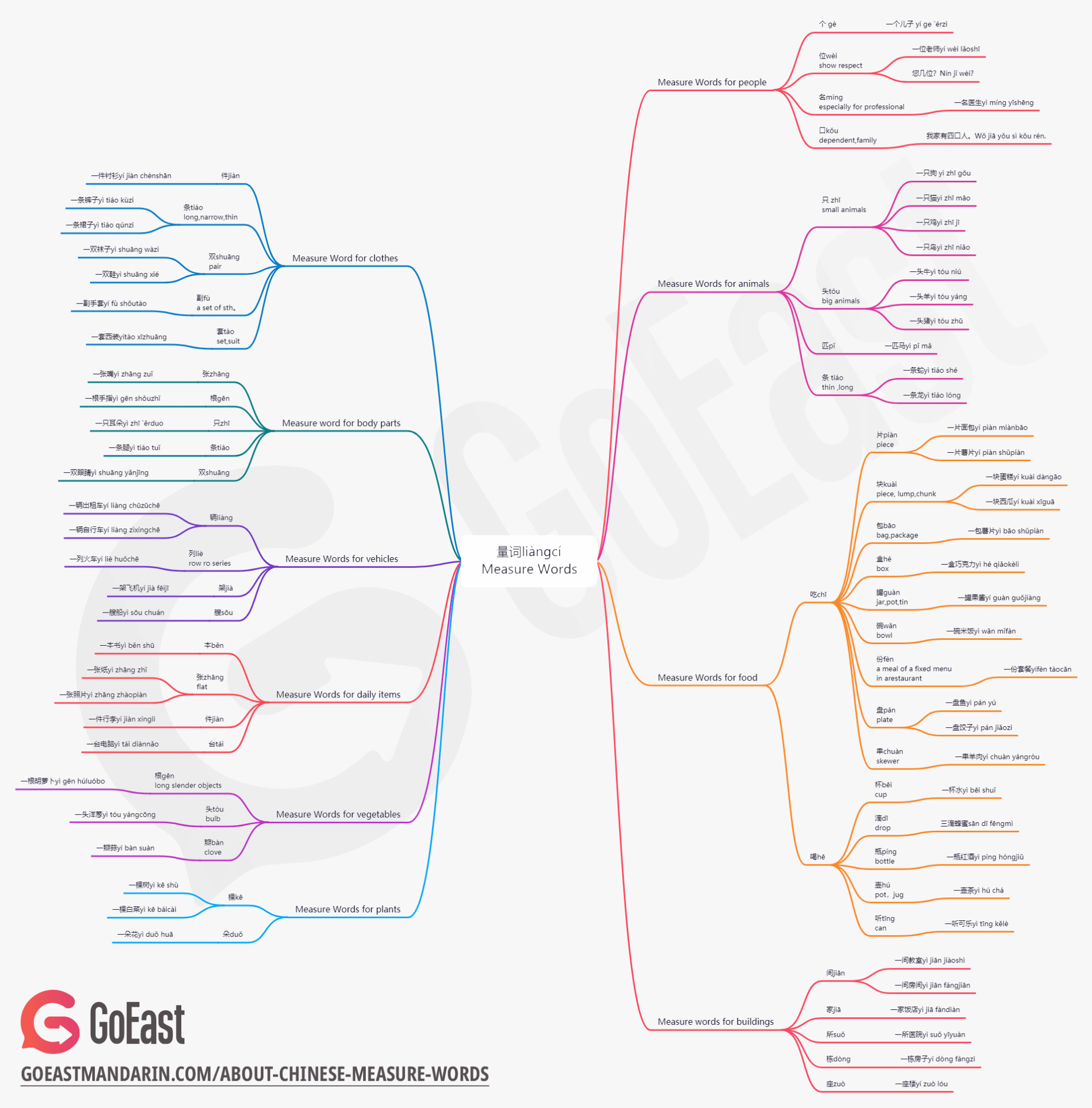
When the container becomes the counting unit
Chinese often turns a container noun into the measure word for its contents. 一杯水 yì bēi shuǐ counts a serving of water, whereas 一个杯子 yí gè bēizi counts the cup itself. Likewise, 一碗饭 counts the food in a bowl, while 一个碗 yí gè wǎn counts the physical bowl.
This distinction shows why classifier choice carries meaning. If someone offers flowers, 一朵花 yì duǒ huā is one bloom, while 一束花 yí shù huā is a bouquet. If you ask for 三滴水 instead of 三杯水, you have requested three drops rather than three glasses. The classifier changes the quantity being described.
When can you use 个, and when does it not work?
个 is the most flexible general classifier and a practical fallback in conversation, but it is not a universal replacement. It naturally counts many people and common objects, and listeners may understand it when a learner does not know a more specific word. However, using it everywhere can sound unnatural, remove useful meaning, or produce a nonstandard phrase.
- Use 个 naturally with common combinations such as 一个人, 一个苹果, and 一个问题.
- Use it as a temporary fallback when speaking quickly and you genuinely do not know the conventional classifier; communication is often better than silence.
- Do not rely on it for established pairings you already know. Say 一本书, not 一个书 yí gè shū; say 一杯茶, not 一个茶 yí gè chá.
- Choose the classifier that expresses your intended unit. A cup, bottle, drop, or bowl describes a different amount even when the noun is identical.
A good rule is: use the specific classifier when you know it; use 个 to keep a conversation moving when you do not; then look up and learn the natural pairing afterward.
How do measure words work in real conversations?
Measure words appear whenever speakers count, point to, select, order, or ask about nouns. The following short exchanges show the five essentials doing real communicative work.
At a café
你要喝什么?Nǐ yào hē shénme? — What would you like to drink?
请给我一杯咖啡。Qǐng gěi wǒ yì bēi kāfēi. — Please give me a cup of coffee.
Talking about a purchase
你买了什么?Nǐ mǎi le shénme? — What did you buy?
我买了一本书和两件衣服。Wǒ mǎi le yì běn shū hé liǎng jiàn yīfu. — I bought a book and two items of clothing.
Choosing a restaurant
附近有餐厅吗?Fùjìn yǒu cāntīng ma? — Are there restaurants nearby?
有,那边有一家很好的餐厅。Yǒu, nàbian yǒu yì jiā hěn hǎo de cāntīng. — Yes, there is a very good restaurant over there.
Introducing someone
这是谁?Zhè shì shéi? — Who is this?
这是我的一个好朋友。Zhè shì wǒ de yí gè hǎo péngyou. — This is a good friend of mine.
What common measure-word mistakes should you avoid?
The two biggest errors are omitting the classifier and treating 个 as correct for every noun. A third is translating English units mechanically without checking what the Chinese phrase actually counts.
- Do not skip the measure word. 我有两书 Wǒ yǒu liǎng shū is not the normal Mandarin structure. Say 我有两本书 Wǒ yǒu liǎng běn shū (I have two books).
- Do not use 个 for a book. 我买了一个书 Wǒ mǎi le yí gè shū sounds nonstandard. Use 我买了一本书 Wǒ mǎi le yì běn shū.
- Do not confuse an object with its contents. 一个杯子 is one physical cup; 一杯水 is one cupful of water.
- Do not ignore tone sandhi in speech. Write 一 in both cases, but pronounce 一个人 with yí and 一本书 with yì.
- Do not assume one noun always takes only one classifier. Different classifiers can present different units or features, as with one flower versus one bouquet of flowers.
Classifier choice is partly semantic and partly conventional. Patterns help you predict, but reliable usage comes from learning the classifier together with its noun and example phrase.
How can you learn measure words efficiently?
Learn measure words as noun partnerships, not as isolated definitions. Instead of memorizing “本 means classifier for books,” store the complete phrase 一本书 and reuse its pattern with magazines and notebooks.
- Master five high-frequency classifiers. Begin with 个, 杯, 本, 家, and 件, then add 碗, 张, and 只.
- Group new words by logic. Keep small sets for containers, shapes, animals, people, vehicles, events, and written material.
- Save one full phrase. Include a number, classifier, noun, and sentence so you learn grammar and context together.
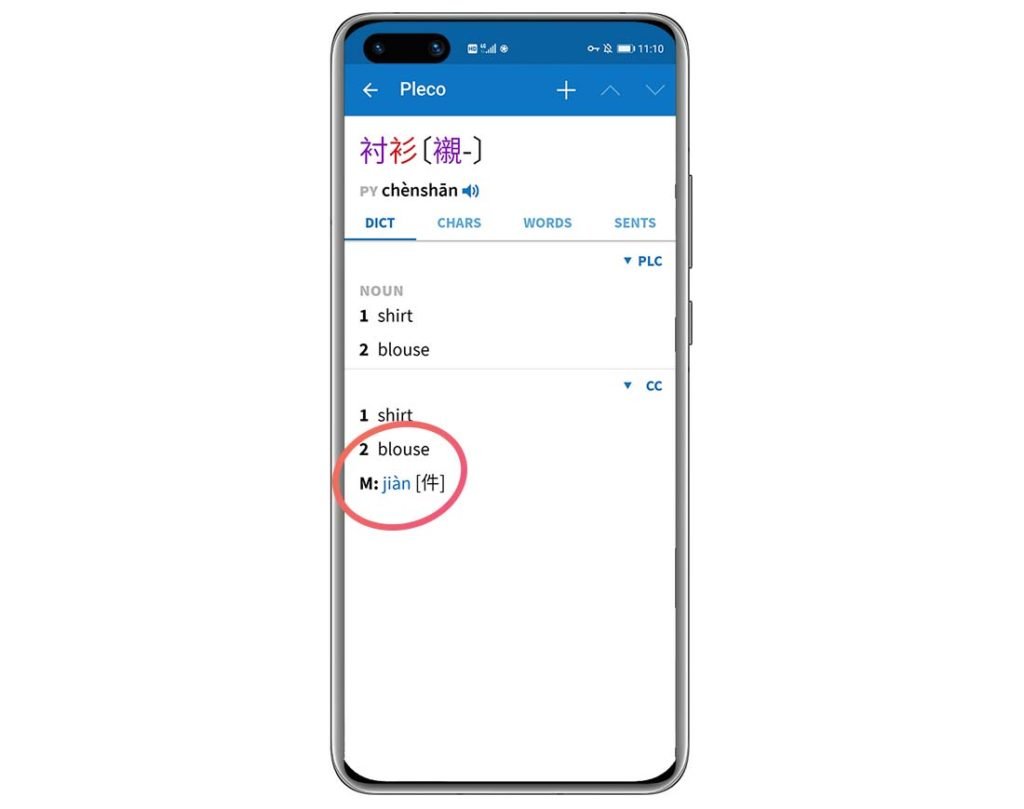
- Check a dictionary. Pleco entries often show a noun’s common classifier. Search the noun—for example, 衬衫 chènshān (shirt)—and note the classifier 件 with it.
- Practice retrieval in situations. Describe what you ordered, bought, saw, or own. Producing a phrase from a scene builds faster recall than rereading a list.
There is no fixed number every learner must memorize. Different references count differently because classifier inventories can include conventional noun classifiers, container units, collective units, and standard measurements. Some practical teaching lists cite about 187 Chinese measure words, while larger dictionaries may include many more. Around 100 can provide broad daily coverage, but beginners gain much more by using the first five accurately than by recognizing a hundred without context. You can align your next vocabulary targets with GoEast’s Chinese words and phrases by HSK level.
Key takeaways
- Core structure: Number + Measure Word + Noun, as in 两本书.
- Best beginner set: learn 个, 杯, 本, 家, and 件 first.
- Useful fallback: 个 keeps many conversations moving, but it cannot naturally replace every classifier.
- Meaning matters: classifiers can show container, shape, category, function, or grouping.
- Efficient practice: memorize complete noun phrases and verify unfamiliar pairings in a dictionary.
Make measure words automatic in conversation
Practice real café orders, purchases, and everyday descriptions with a GoEast Mandarin teacher in an online trial class.
Frequently asked questions
What are Chinese measure words?
Chinese measure words are grammatical units placed between a number or demonstrative and a noun. They identify the unit or category being counted, as 本 does in 两本书, “two books.”
How many Chinese measure words are there?
There is no universally agreed total because references define and group classifiers differently. Practical lists may cite around 187, while broader dictionaries include more; roughly 100 gives wide coverage, but beginners can start with five essential words.
Why do we use measure words in Chinese?
Mandarin normally requires a counting unit between a quantity and a noun. That classifier also provides information about the noun’s category, shape, container, function, or grouping.
Can I always use 个 as a Chinese classifier?
No. 个 is a flexible default and can help when you do not know a specific classifier, but fixed combinations still matter: 一本书 is natural for “one book,” while 一个书 is nonstandard.
What is the basic structure for measure words in Chinese?
The basic counting structure is Number + Measure Word + Noun, such as 三杯咖啡 for “three cups of coffee.” Demonstratives and question words can fill the quantity position too, as in 这本书, “this book.”
Why is 一 pronounced yí in 一个 but yì in 一本?
一 changes tone in connected speech: it is usually yí before a fourth-tone syllable such as gè, and yì before first-, second-, or third-tone syllables such as běn. Its written character remains 一.
What are the best Chinese classifiers for beginners?
Begin with 个 for many general nouns, 杯 for cups of drinks, 本 for bound reading material, 家 for businesses, and 件 for clothing or matters. Then add practical classifiers such as 碗, 张, and 只.