
Chinese Words Vocabulary – 200 Most Useful Words Organized by Topic
Chinese Vocabulary: 200+ Essential Words and Their Meanings
Building a foundation of Chinese vocabulary is the fastest way to start understanding and speaking Mandarin. This guide gives you the core everyday words, shows you how Chinese words are built from characters (so you can often guess their meaning), and adds dozens of themed word lists — all with 汉字 Hànzì, pinyin, and English.
Essential Chinese vocabulary starts with a few hundred high-frequency words — roughly HSK levels 1–2, about 300 words — which cover most everyday situations. Many Chinese words are built from characters whose literal meanings you can guess: 电脑 diànnǎo is literally “electric brain” (computer) and 飞机 fēijī is “flying machine” (airplane). Below you’ll find 200+ core and themed Chinese words with pinyin, English, and their meanings.
How many Chinese words do you need?
You need far fewer words than you might fear. A few hundred high-frequency words — roughly HSK 1–2, about 300 words — let you handle most everyday situations: greetings, shopping, directions, food, and small talk. Mandarin has tens of thousands of characters and hundreds of thousands of words, but native-level daily life runs on a surprisingly small core.
The official HSK exam is a useful map because vocabulary roughly doubles each level. Here is how the word counts stack up:
| HSK level | Cumulative words | What you can do |
|---|---|---|
| HSK 1 | 150 | Greet people, introduce yourself, basic phrases |
| HSK 2 | 300 | Simple everyday tasks and routine conversation |
| HSK 3 | 600 | Handle most travel and daily-life situations |
| HSK 4 | 1,200 | Discuss a range of topics with some fluency |
| HSK 5 | 2,500 | Read newspapers, watch films, give speeches |
| HSK 6 | 5,000 | Near-native comprehension across most topics |
Don’t be daunted by 5,000 words for HSK 6. Each level builds on the last, so if you can learn the first 2,500 words, the next 2,500 come far more easily. Start with the HSK 1 vocabulary list and grow from there.
The most common Chinese words (with meanings)
Start here. These are the highest-frequency Chinese words — the ones you’ll use in almost every conversation. Many already show the logic of Chinese: 你好 nǐ hǎo literally means “you good,” and 再见 zàijiàn is “again see.”
| English | 汉字 Hànzì | Pīnyīn | Note / literal meaning |
|---|---|---|---|
| Hello | 你好 | nǐ hǎo | literally “you good” |
| Thank you | 谢谢 | xièxie | add 您 nín for politeness: 谢谢您 |
| Goodbye | 再见 | zàijiàn | literally “again see” |
| Please | 请 | qǐng | polite requests: 请坐 qǐng zuò “please sit” |
| Sorry | 对不起 | duìbuqǐ | genuine apology |
| To be / yes | 是 | shì | also confirms “Are you…?” questions |
| Not / no | 不 | bù | negates verbs and adjectives |
| Good | 好 | hǎo | 女 woman + 子 child |
| I / me | 我 | wǒ | — |
| You | 你 | nǐ | — |
| He / she | 他 / 她 | tā | same sound, different character |
| What | 什么 | shénme | usually follows the verb |
| Who | 谁 | shéi | — |
| Where | 哪里 | nǎlǐ | — |
| How much / many | 多少 | duōshao | literally “much few” |
| To eat | 吃 | chī | — |
| To drink | 喝 | hē | — |
| To go | 去 | qù | — |
| To come | 来 | lái | — |
| Water | 水 | shuǐ | — |
| Person | 人 | rén | a pictograph of a walking person |
| Home / family | 家 | jiā | 宀 roof + 豕 pig |
Worked example. Combine four core words — 我 wǒ (I), 要 yào (want), 喝 hē (drink), 水 shuǐ (water).
Result: 我要喝水 Wǒ yào hē shuǐ — “I want to drink water.” Chinese word order mirrors English here (subject–verb–object), so a handful of core words already builds real sentences.
For the next tier, see our 100 essential Chinese words and phrases, or browse words and phrases by HSK level.
Chinese words and their meanings: how characters build words
Here’s what makes Chinese vocabulary easier than it looks: most everyday words are compounds built from simpler characters, and the combined meaning is often guessable. Learn the building blocks once and you unlock the meaning of hundreds of words. There are two layers to this: how words are built from characters, and how characters themselves are built from radicals.
Words built from characters (guessable meanings)
A Chinese “word” is usually one or two characters. When you know the pieces, the meaning often clicks into place — 电脑 diànnǎo is literally “electric brain.”
| Word | 汉字 Hànzì | Pīnyīn | Literal meaning (character by character) |
|---|---|---|---|
| Computer | 电脑 | diànnǎo | 电 electric + 脑 brain |
| Airplane | 飞机 | fēijī | 飞 to fly + 机 machine |
| Train | 火车 | huǒchē | 火 fire + 车 vehicle |
| Telephone | 电话 | diànhuà | 电 electric + 话 speech |
| Mobile phone | 手机 | shǒujī | 手 hand + 机 machine |
| Television | 电视 | diànshì | 电 electric + 视 to view |
| Sun | 太阳 | tàiyáng | 太 great + 阳 yang (sun principle) |
| Birthday | 生日 | shēngrì | 生 birth + 日 day |
| Tomorrow | 明天 | míngtiān | 明 bright + 天 day |
| China | 中国 | Zhōngguó | 中 middle + 国 country (“Middle Kingdom”) |
| Chinese (language) | 中文 | zhōngwén | 中 China + 文 writing / language |
| Restaurant | 饭店 | fàndiàn | 饭 meal + 店 shop |
Characters built from radicals
Characters themselves are built from about 200 radicals — meaningful building blocks. Once you spot the components, many characters stop being random strokes and start telling a small story.
Good · 好 hǎo
女 + 子
A woman (女) beside a child (子) — a classic image of “good.”
Home · 家 jiā
宀 + 豕
A roof (宀) over a pig (豕) — livestock under a roof meant “home.”
Rest · 休 xiū
亻 + 木
A person (亻) leaning against a tree (木) — to rest.
Bright · 明 míng
日 + 月
The sun (日) and moon (月) together — brightness.
Woods / forest · 林 / 森 lín / sēn
木 × 2 / × 3
Two trees make “woods” (林); three trees make “forest” (森).
Some words also carry meanings beyond their parts. A single character like 水 shuǐ (“water”) can appear in slang to mean “weak” or “watered-down,” so context always matters. To get the sounds right as you learn meanings, see our guide to Chinese pronunciation.
Chinese vocabulary by topic
Learning words in themed groups makes them stick — your brain links related ideas together. Over the years we’ve shared vocabulary cards on dozens of topics; here they are collected in one place, from everyday basics to Star Wars and hotpot.
Basic Chinese nouns, verbs, and question words
Core everyday vocabulary to build on after the most common words above.
| English | 汉字 Hànzì | Pīnyīn |
|---|---|---|
| Student | 学生 | xuésheng |
| Mister | 先生 | xiānshēng |
| Miss | 小姐 | xiǎojiě |
| Teacher | 老师 | lǎoshī |
| Doctor | 医生 | yīshēng |
| How many | 几 | jǐ |
| How | 怎么 | zěnme |
| Why | 为什么 | wèishénme |
| Now | 现在 | xiànzài |
| Today | 今天 | jīntiān |
| Yesterday | 昨天 | zuótiān |
| Thing | 东西 | dōngxi |
| Here | 这里 | zhèlǐ |
| There | 那里 | nàlǐ |
Want to navigate too? Learn the terms for directions in Mandarin.
Star Wars vocabulary in Chinese
For when your Chinese friends want to talk about the latest film. See more Star Wars names and phrases in Chinese.
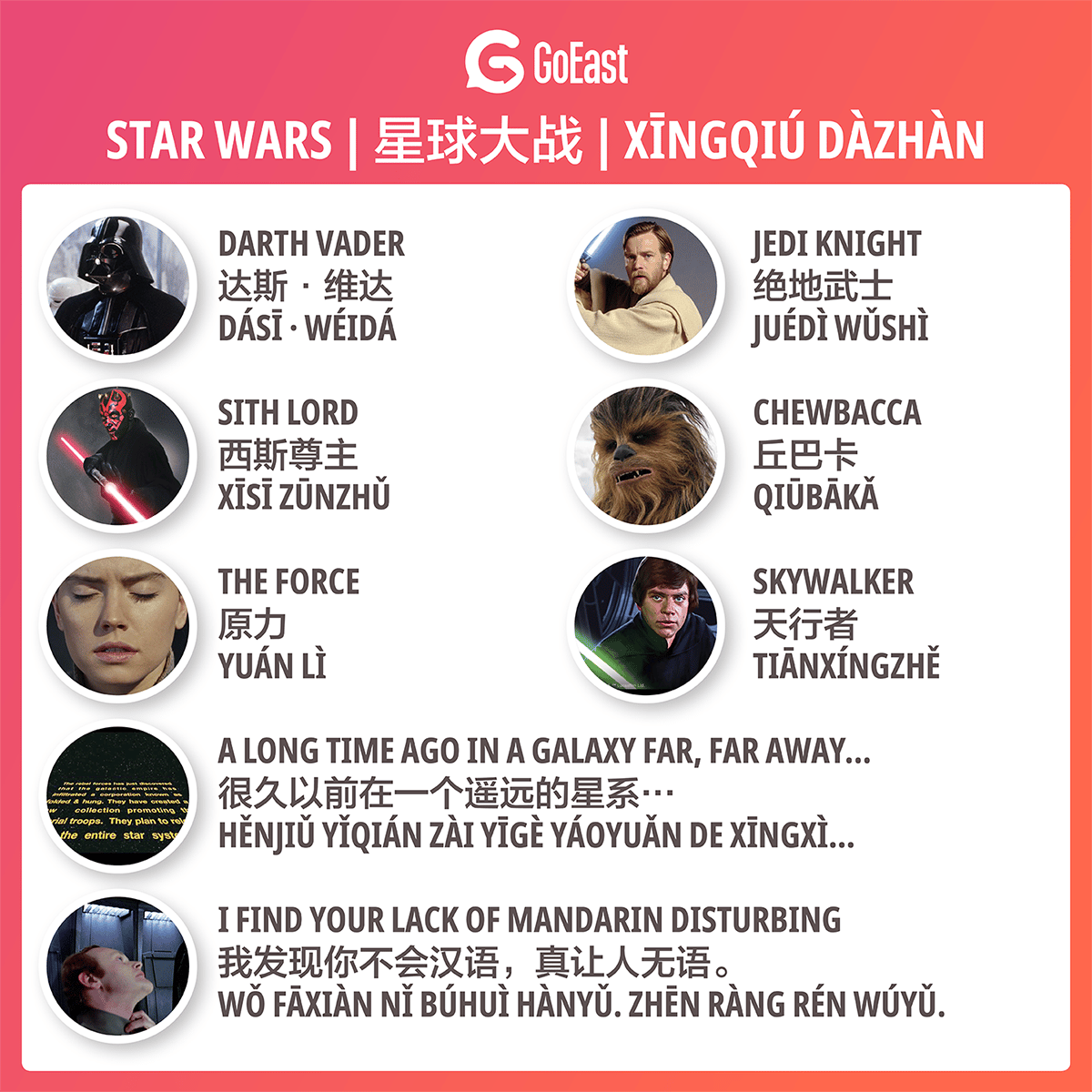
| English | 汉字 Hànzì | Pīnyīn |
|---|---|---|
| Darth Vader | 达斯维达 | dá sī wéi dá |
| Jedi Knight | 绝地武士 | jué dì wǔ shì |
| Sith Lord | 西斯尊主 | xī sī zūn zhǔ |
| Chewbacca | 丘巴卡 | qiū bā kǎ |
| The Force | 原力 | yuán lì |
| Skywalker | 天行者 | tiān xíng zhě |
Pokémon names in Chinese
You know Pikachu and Psyduck — but do you know their Mandarin names? More on Pokémon in Chinese here.
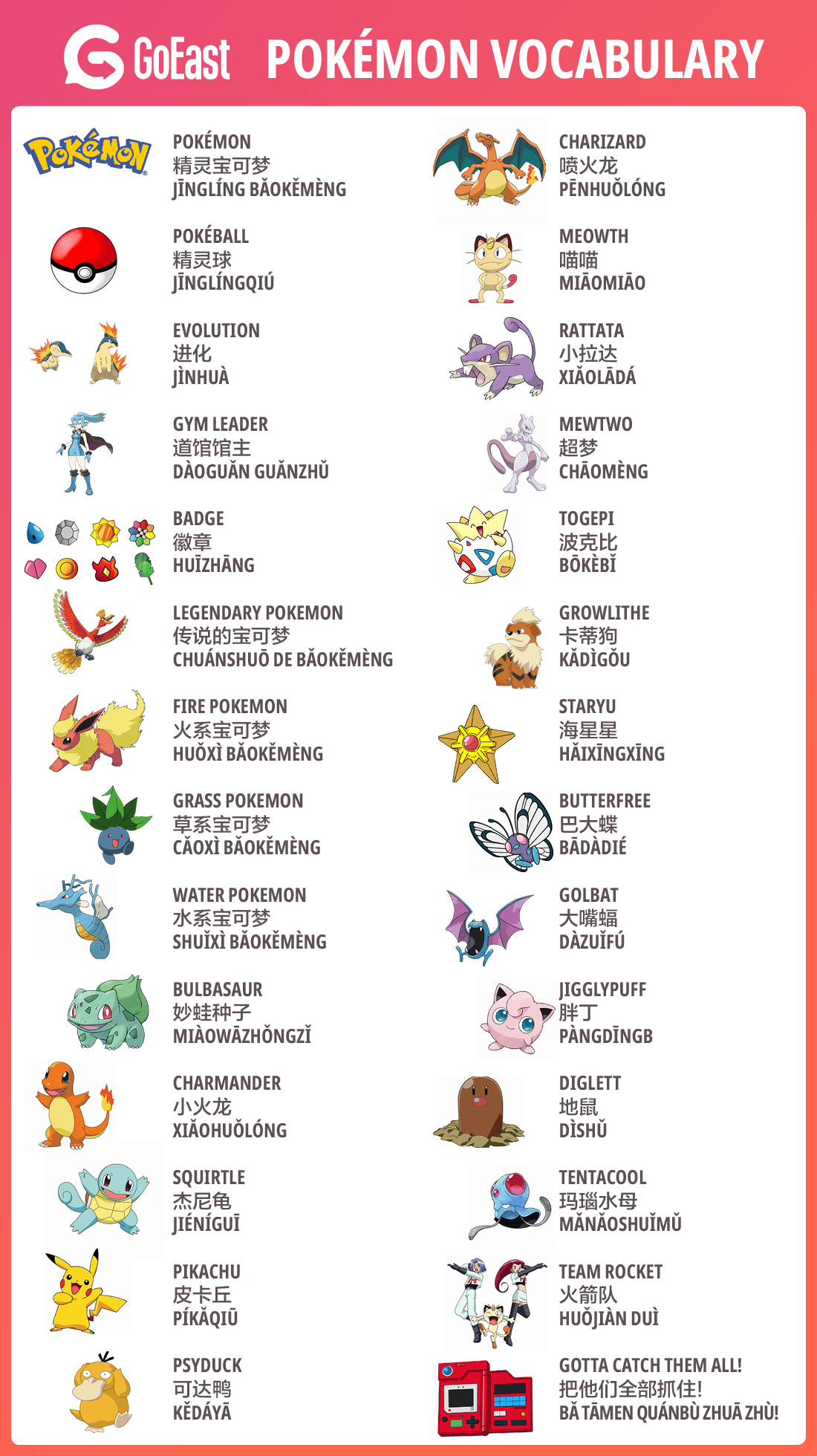
| English | 汉字 Hànzì | Pīnyīn |
|---|---|---|
| Pokémon | 精灵宝可梦 | jīng líng bǎo kě mèng |
| Pikachu | 皮卡丘 | pí kǎ qiū |
| Charizard | 喷火龙 | pēn huǒ lóng |
| Charmander | 小火龙 | xiǎo huǒ lóng |
| Squirtle | 杰尼龟 | jié ní guī |
| Bulbasaur | 妙蛙种子 | miào wā zhǒng zi |
| Jigglypuff | 胖丁 | pàng dīng |
| Meowth | 喵喵 | miāo miāo |
| Psyduck | 可达鸭 | kě dá yā |
| Mewtwo | 超梦 | chāo mèng |
| Poké Ball | 精灵球 | jīng líng qiú |
| Evolution | 进化 | jìn huà |
| Gym Leader | 道馆馆主 | dào guǎn guǎn zhǔ |
| Team Rocket | 火箭队 | huǒ jiàn duì |
| Legendary Pokémon | 传说的宝可梦 | chuán shuō de bǎo kě mèng |
Yoga and meditation terms in Chinese
Vocabulary for slowing down and breathing out.
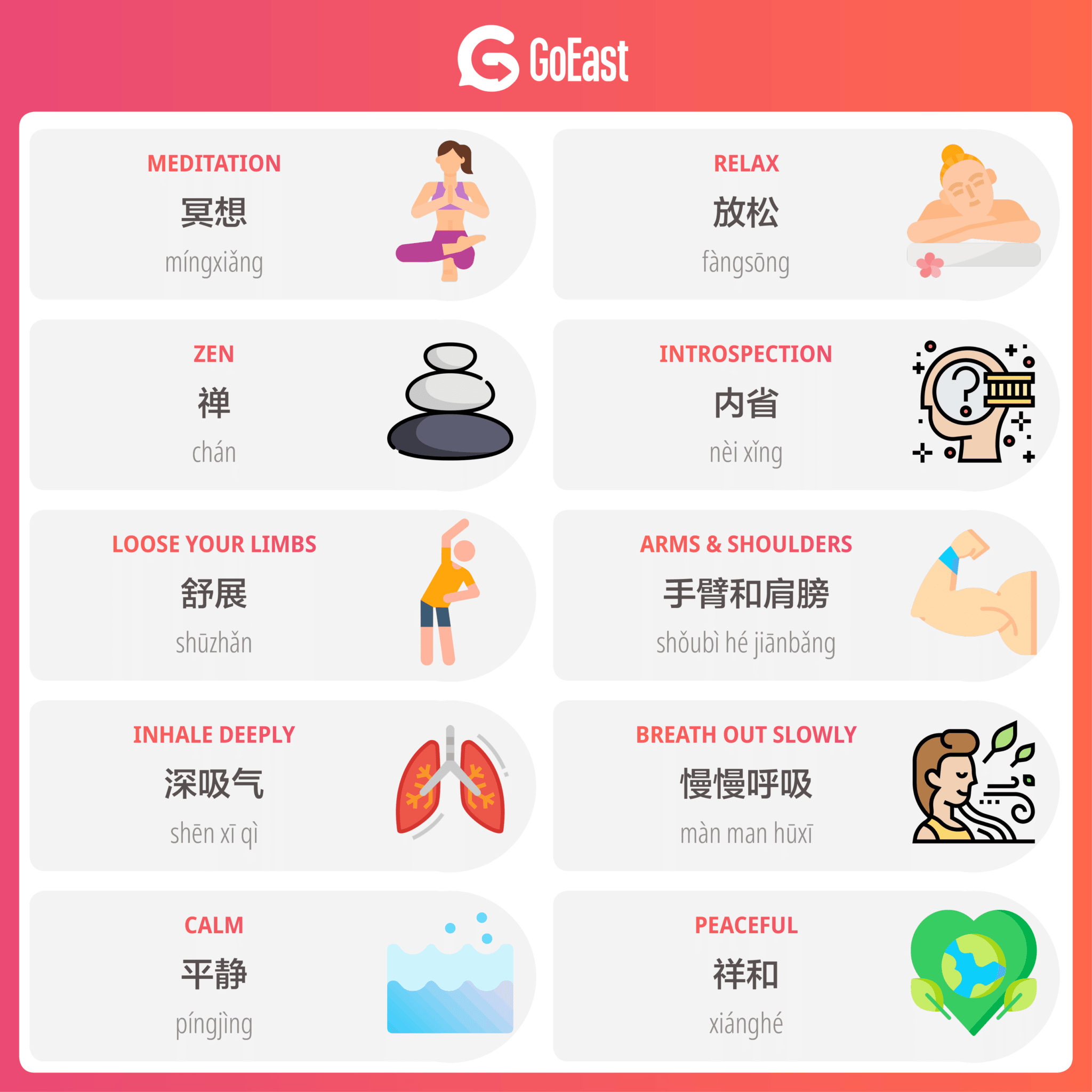
| English | 汉字 Hànzì | Pīnyīn |
|---|---|---|
| Meditation | 冥想 | míng xiǎng |
| Relax | 放松 | fàng sōng |
| Zen | 禅 | chán |
| Introspection | 内省 | nèi xǐng |
| Stretch out | 舒展 | shū zhǎn |
| Arms & shoulders | 手臂和肩膀 | shǒu bì hé jiān bǎng |
| Inhale deeply | 深吸气 | shēn xī qì |
| Breathe out slowly | 慢慢呼吸 | màn màn hū xī |
| Calm | 平静 | píng jìng |
| Peaceful | 祥和 | xiáng hé |
Chinese job-hunting words
Learning Chinese for your career? These terms come up in any job search.
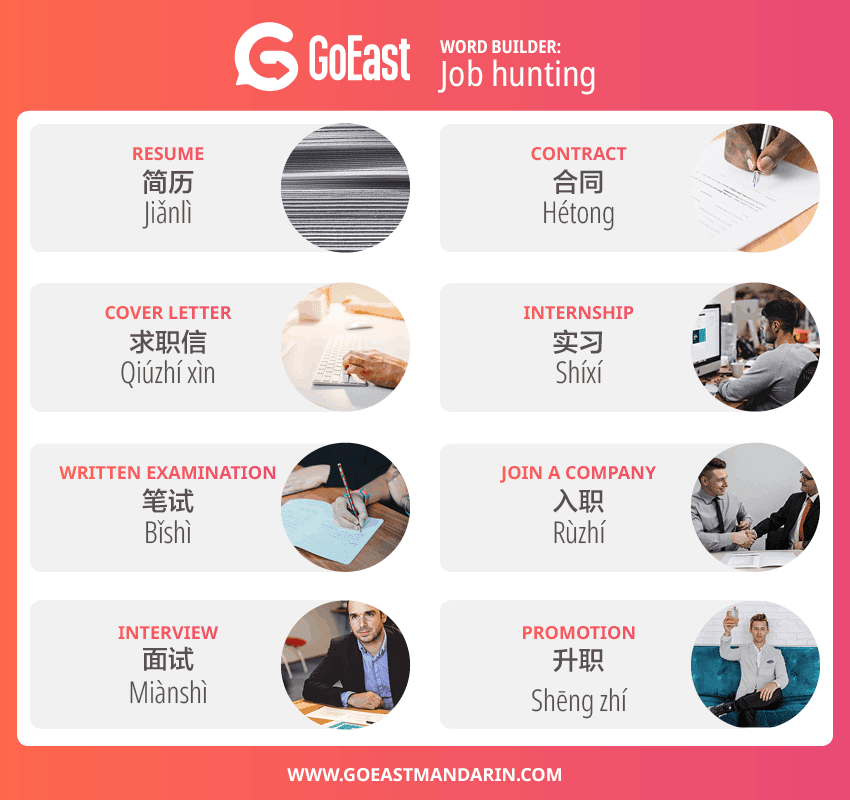
| English | 汉字 Hànzì | Pīnyīn |
|---|---|---|
| Resume | 简历 | jiǎn lì |
| Cover letter | 求职信 | qiú zhí xìn |
| Interview | 面试 | miàn shì |
| Written examination | 笔试 | bǐ shì |
| Internship | 实习 | shí xí |
| Contract | 合同 | hé tóng |
| Join a company | 入职 | rù zhí |
| Promotion | 升职 | shēng zhí |
Going further in your career? Explore our Business Chinese course.
Working-from-home vocabulary
Talk about remote work in Mandarin.
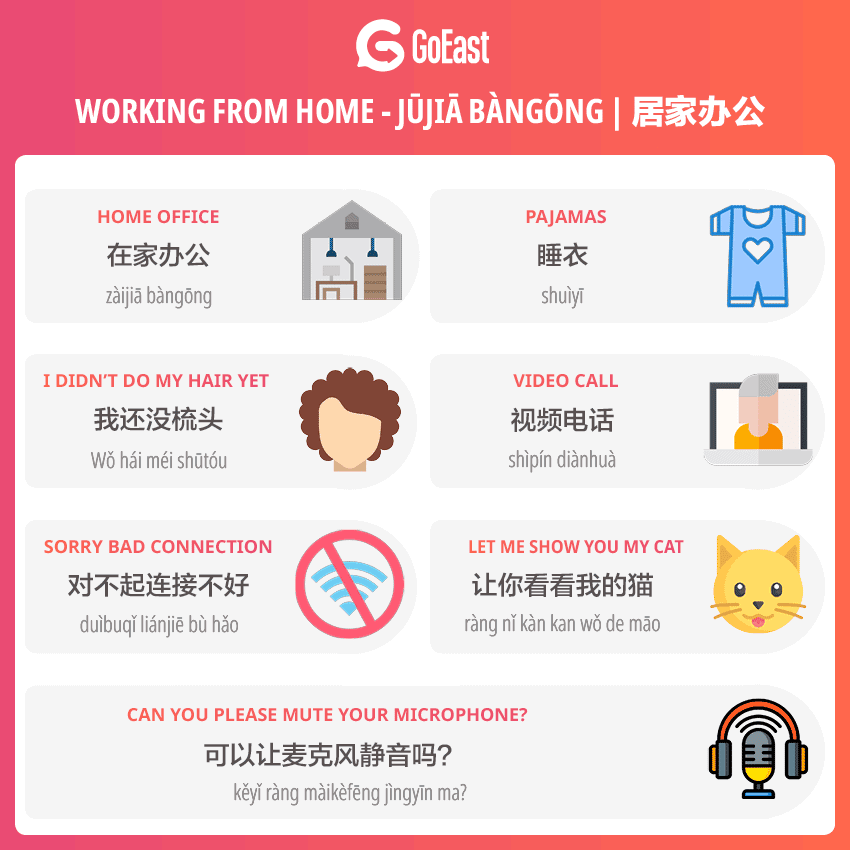
| English | 汉字 Hànzì | Pīnyīn |
|---|---|---|
| Work from home | 在家办公 | zài jiā bàn gōng |
| Video call | 视频电话 | shì pín diàn huà |
| Pajamas | 睡衣 | shuì yī |
| I haven’t done my hair yet | 我还没梳头 | wǒ hái méi shū tóu |
| Sorry, bad connection | 对不起,连接不好 | duì bù qǐ, lián jiē bù hǎo |
| Can you mute your microphone? | 可以让麦克风静音吗 | kě yǐ ràng mài kè fēng jìng yīn ma |
| Let me show you my cat | 让你看看我的猫 | ràng nǐ kàn kàn wǒ de māo |
Romantic Chinese vocabulary
Vocabulary for Valentine’s Day, 520, or any date — no guarantees on the smooth-talking, but your Mandarin will be correct.
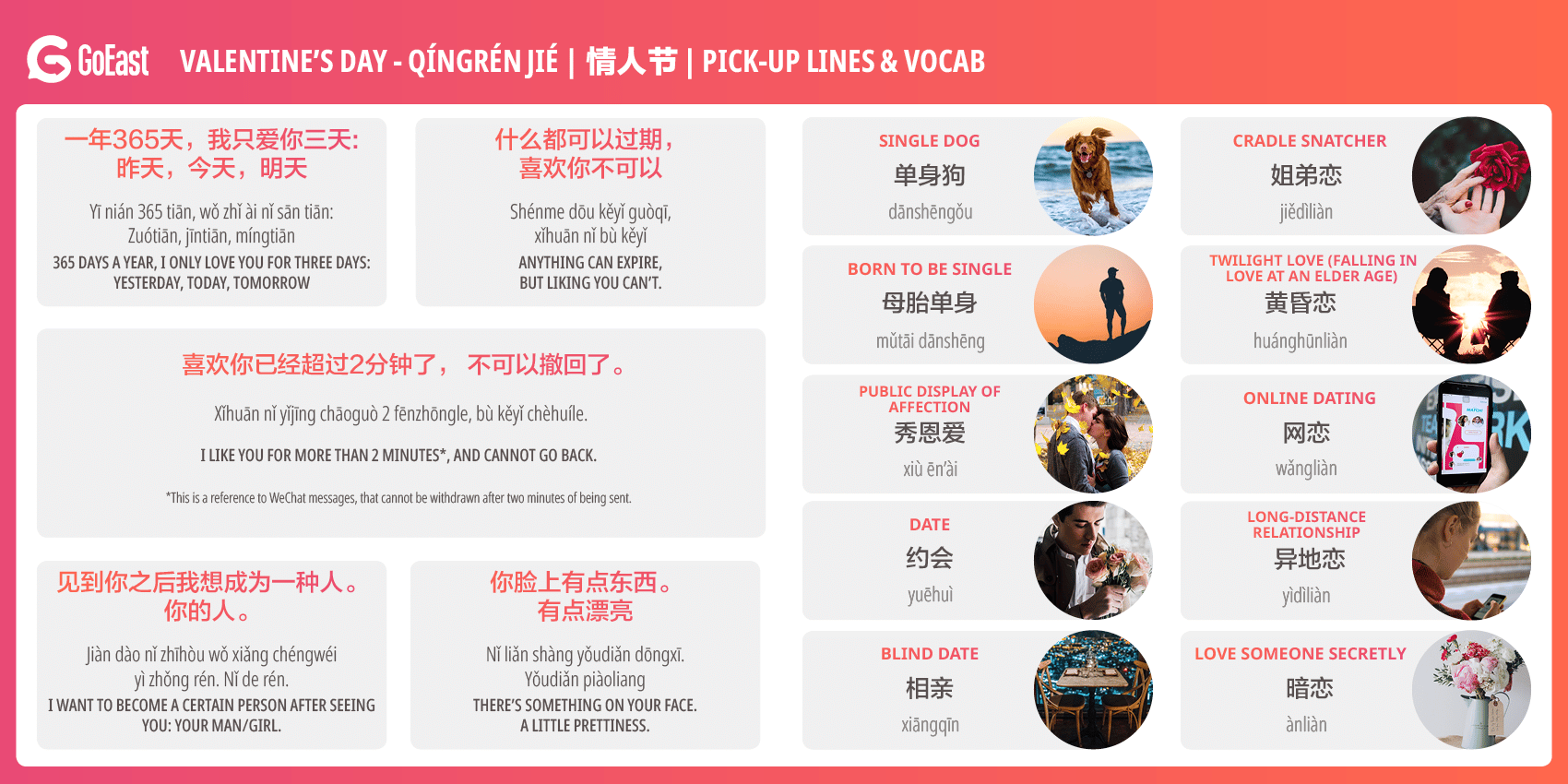
| English | 汉字 Hànzì | Pīnyīn |
|---|---|---|
| Date (romantic) | 约会 | yuē huì |
| Single (self-deprecating slang) | 单身狗 | dān shēn gǒu |
| Born to be single | 母胎单身 | mǔ tāi dān shēn |
| Long-distance relationship | 异地恋 | yì dì liàn |
| Older partner with younger one | 姐弟恋 | jiě dì liàn |
| Twilight love (later in life) | 黄昏恋 | huáng hūn liàn |
| Public display of affection | 秀恩爱 | xiù ēn ài |
LGBT vocabulary in Mandarin
This list isn’t exhaustive, but it’ll help you talk about LGBT topics more accurately and respectfully in Chinese.
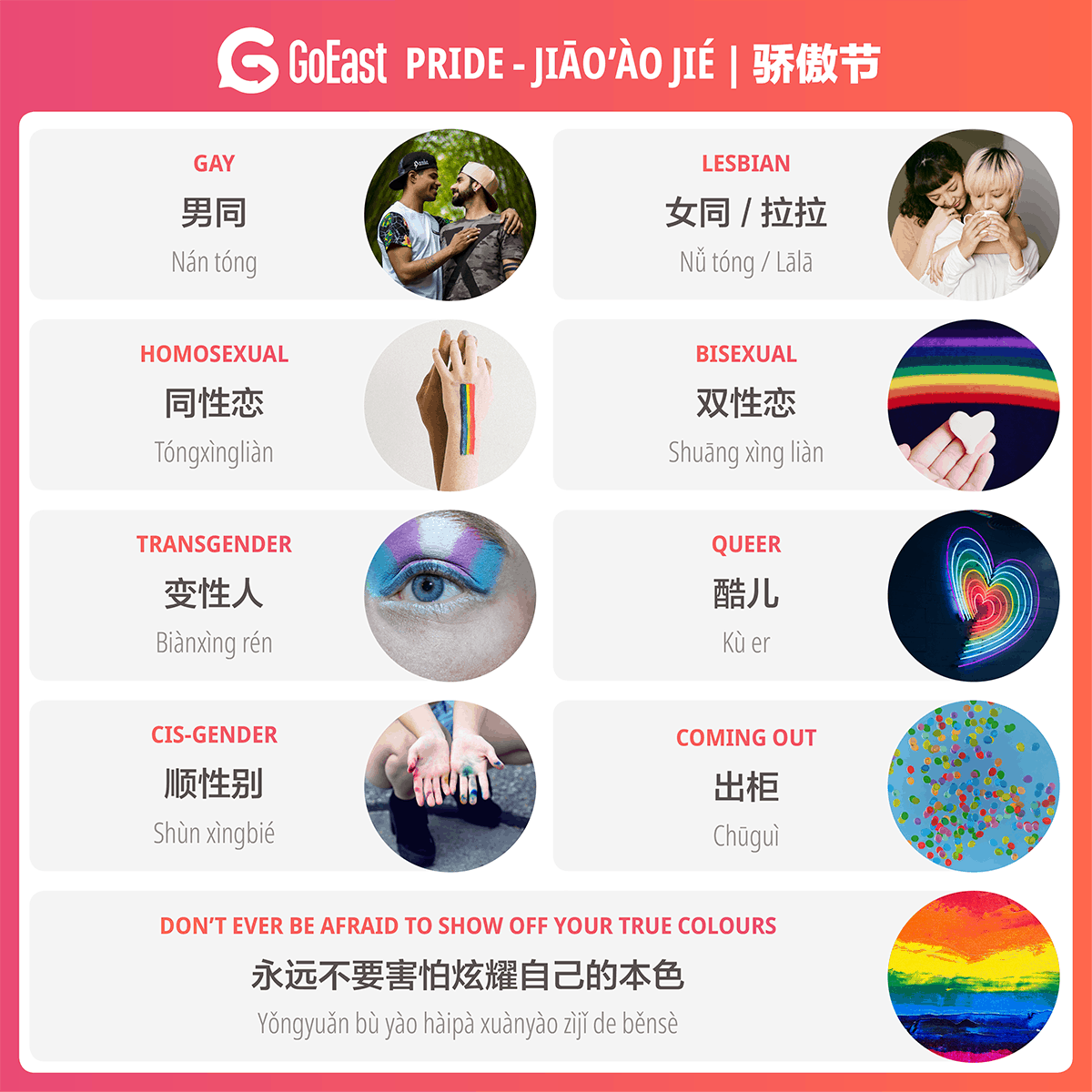
| English | 汉字 Hànzì | Pīnyīn |
|---|---|---|
| Gay (male) | 男同 | nán tóng |
| Lesbian | 女同 / 拉拉 | nǚ tóng / lā lā |
| Homosexual | 同性恋 | tóng xìng liàn |
| Bisexual | 双性恋 | shuāng xìng liàn |
| Transgender | 变性人 | biàn xìng rén |
| Queer | 酷儿 | kù ér |
| Cisgender | 顺性别 | shùn xìng bié |
| Coming out | 出柜 | chū guì |
Back-to-school vocabulary
Head back to class well-prepared with these Chinese words.
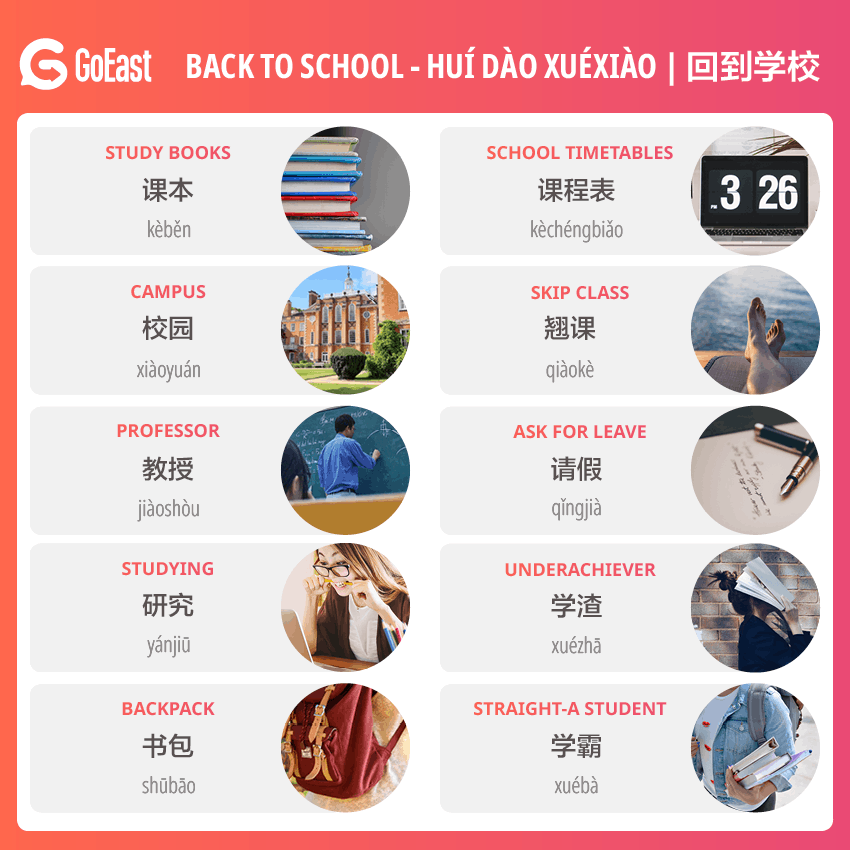
| English | 汉字 Hànzì | Pīnyīn |
|---|---|---|
| Textbook | 课本 | kè běn |
| Timetable | 课程表 | kè chéng biǎo |
| Campus | 校园 | xiào yuán |
| Backpack | 书包 | shū bāo |
| Professor | 教授 | jiào shòu |
| Ask for leave | 请假 | qǐng jià |
| Skip class | 翘课 | qiào kè |
| Top student | 学霸 | xué bà |
| Struggling student | 学渣 | xué zhā |
Chinese spring vocabulary
For when spring is in the air — lambs, blossoms, and hay fever.
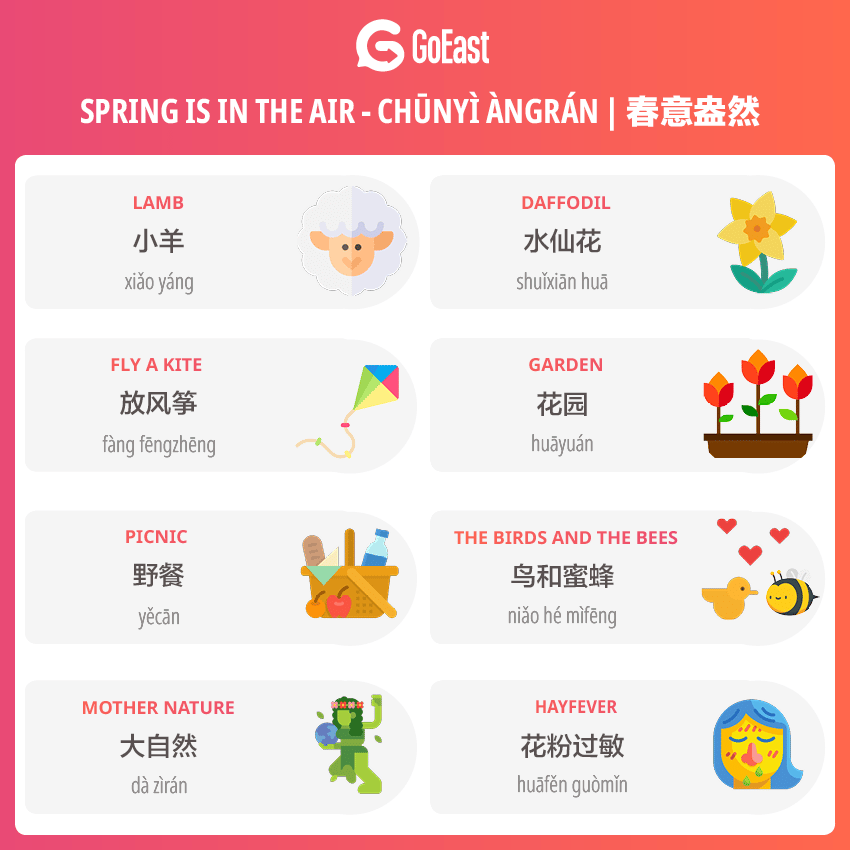
| English | 汉字 Hànzì | Pīnyīn |
|---|---|---|
| Lamb | 小羊 | xiǎo yáng |
| Daffodil | 水仙花 | shuǐ xiān huā |
| Fly a kite | 放风筝 | fàng fēng zhēng |
| Garden | 花园 | huā yuán |
| Picnic | 野餐 | yě cān |
| Mother Nature | 大自然 | dà zì rán |
| Hay fever | 花粉过敏 | huā fěn guò mǐn |
Chinese summer vocabulary
Learn to complain about the heat in Chinese.
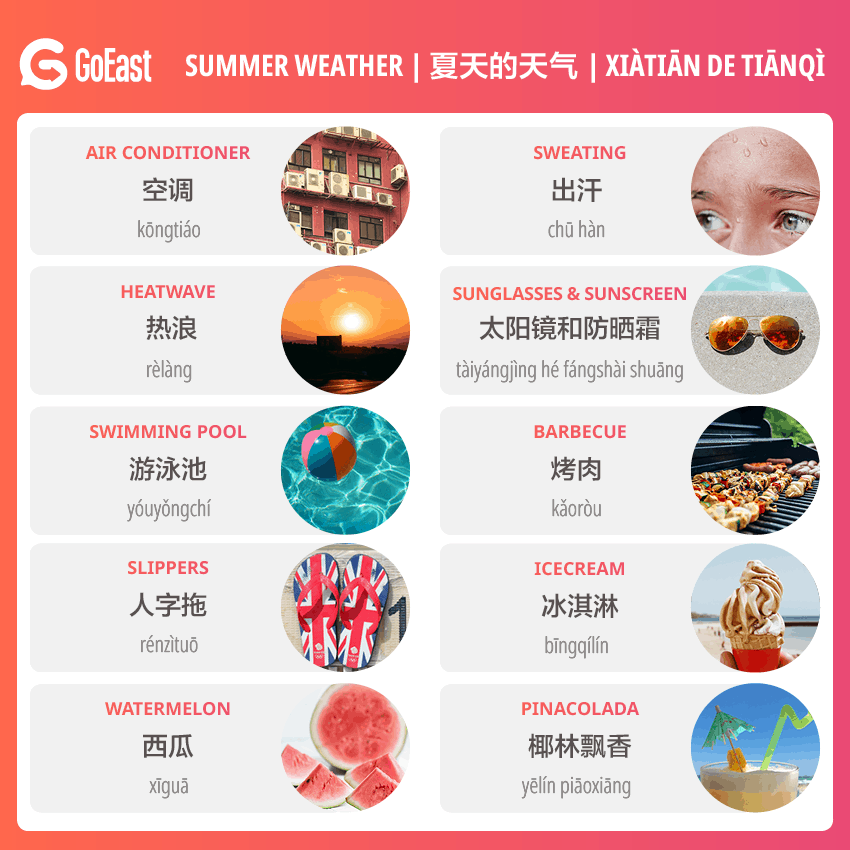
| English | 汉字 Hànzì | Pīnyīn |
|---|---|---|
| Air conditioner | 空调 | kōng tiáo |
| Sweating | 出汗 | chū hàn |
| Heatwave | 热浪 | rè làng |
| Sunglasses & sunscreen | 太阳镜和防晒霜 | tài yáng jìng hé fáng shài shuāng |
| Swimming pool | 游泳池 | yóu yǒng chí |
| Barbecue | 烤肉 | kǎo ròu |
| Ice cream | 冰淇淋 | bīng qí lín |
| Watermelon | 西瓜 | xī guā |
Teacher’s Day vocabulary
How to name teachers of every kind in Chinese — just add thanks and a gift.
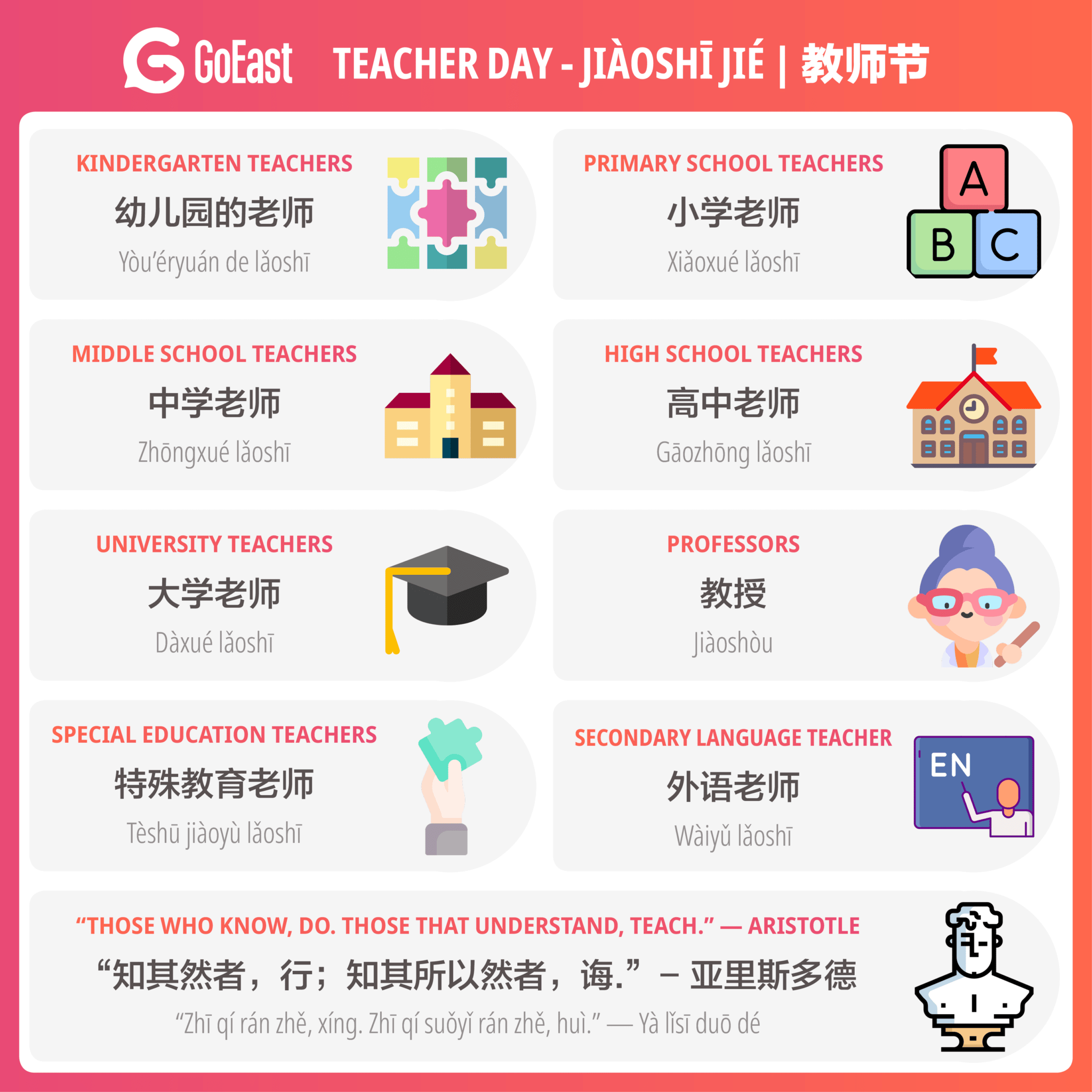
| English | 汉字 Hànzì | Pīnyīn |
|---|---|---|
| Kindergarten teacher | 幼儿园老师 | yòu ér yuán lǎo shī |
| Primary school teacher | 小学老师 | xiǎo xué lǎo shī |
| Middle school teacher | 中学老师 | zhōng xué lǎo shī |
| High school teacher | 高中老师 | gāo zhōng lǎo shī |
| University teacher | 大学老师 | dà xué lǎo shī |
| Professor | 教授 | jiào shòu |
| Foreign language teacher | 外语老师 | wài yǔ lǎo shī |
Mother’s Day vocabulary
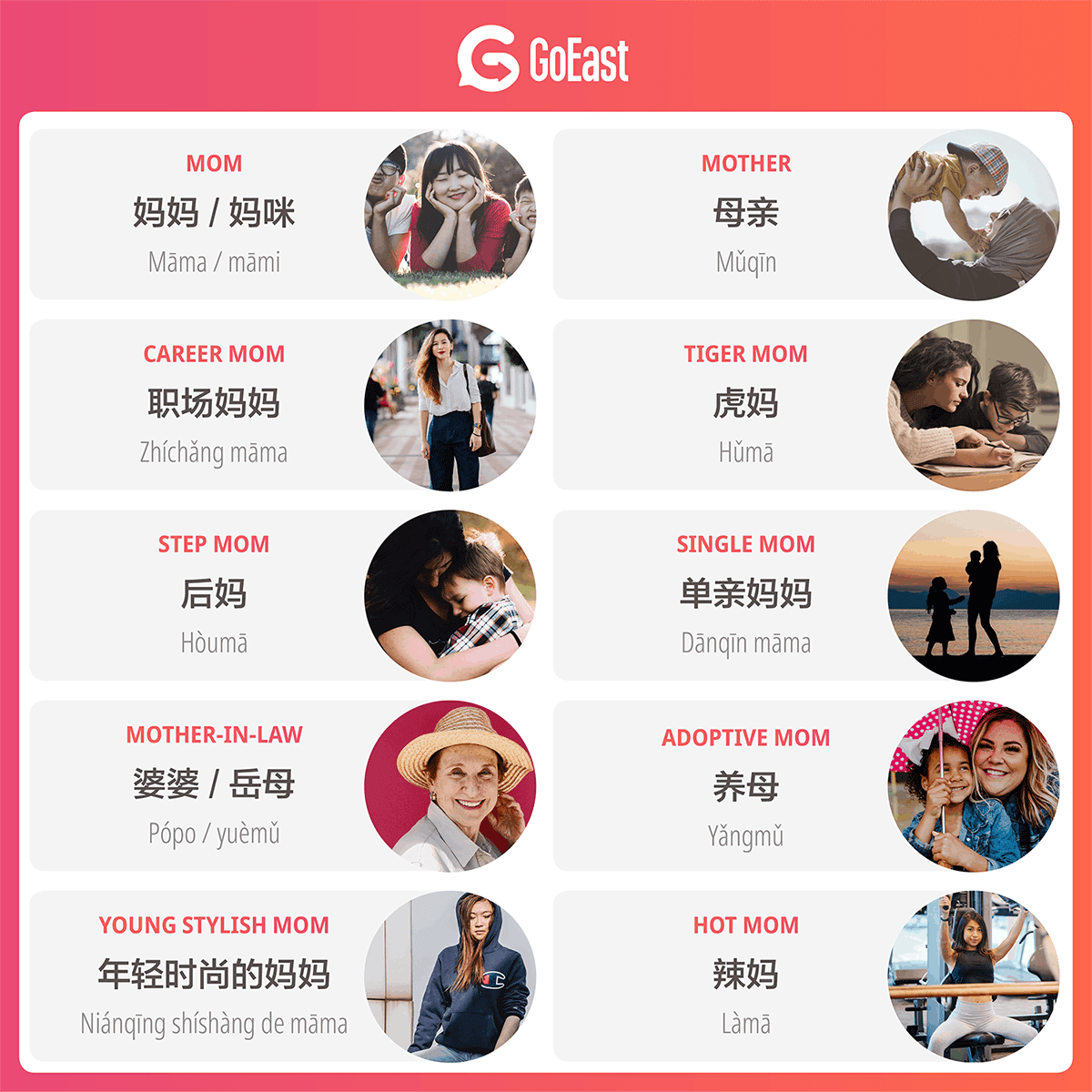
How to name all sorts of moms in Chinese.
| English | 汉字 Hànzì | Pīnyīn |
|---|---|---|
| Mom | 妈妈 / 妈咪 | mā mā / mā mī |
| Mother | 母亲 | mǔ qīn |
| Working mom | 职场妈妈 | zhí chǎng mā mā |
| Tiger mom | 虎妈 | hǔ mā |
| Single mom | 单亲妈妈 | dān qīn mā mā |
| Stepmom | 后妈 | hòu mā |
| Adoptive mom | 养母 | yǎng mǔ |
| Mother-in-law | 婆婆 / 岳母 | pó pó / yuè mǔ |
International Women’s Day vocabulary
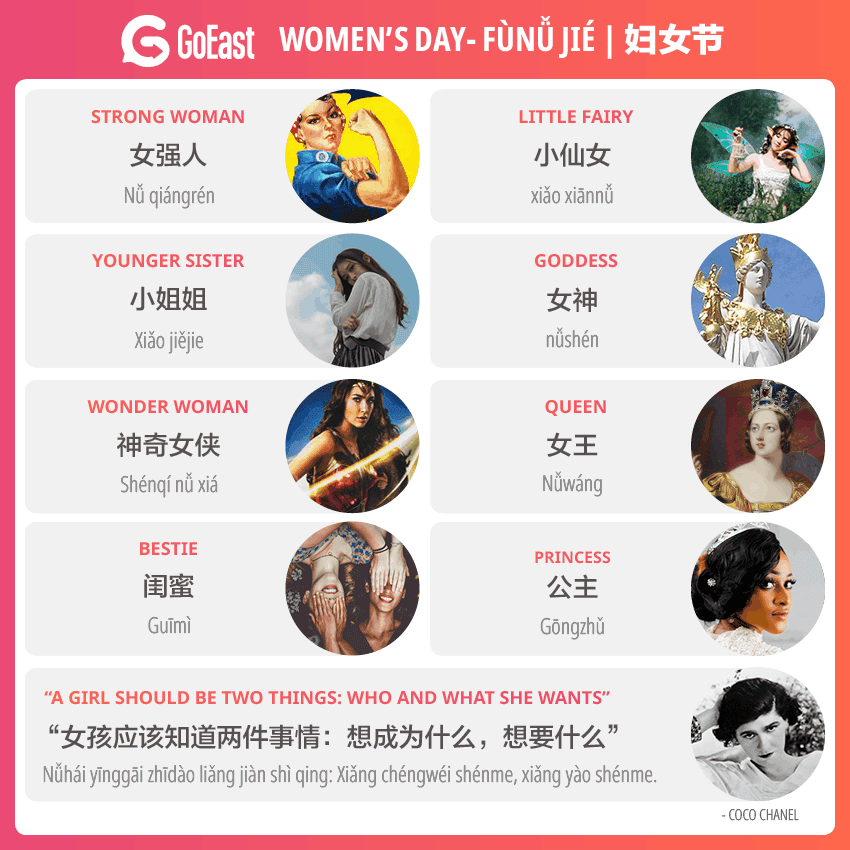
Words to describe an amazing woman.
| English | 汉字 Hànzì | Pīnyīn |
|---|---|---|
| Strong woman | 女强人 | nǚ qiáng rén |
| Goddess | 女神 | nǚ shén |
| Queen | 女王 | nǚ wáng |
| Princess | 公主 | gōng zhǔ |
| Wonder Woman | 神奇女侠 | shén qí nǚ xiá |
| Little fairy (term of endearment) | 小仙女 | xiǎo xiān nǚ |
| Best friend (female) | 闺蜜 | guī mì |
Halloween Chinese vocabulary
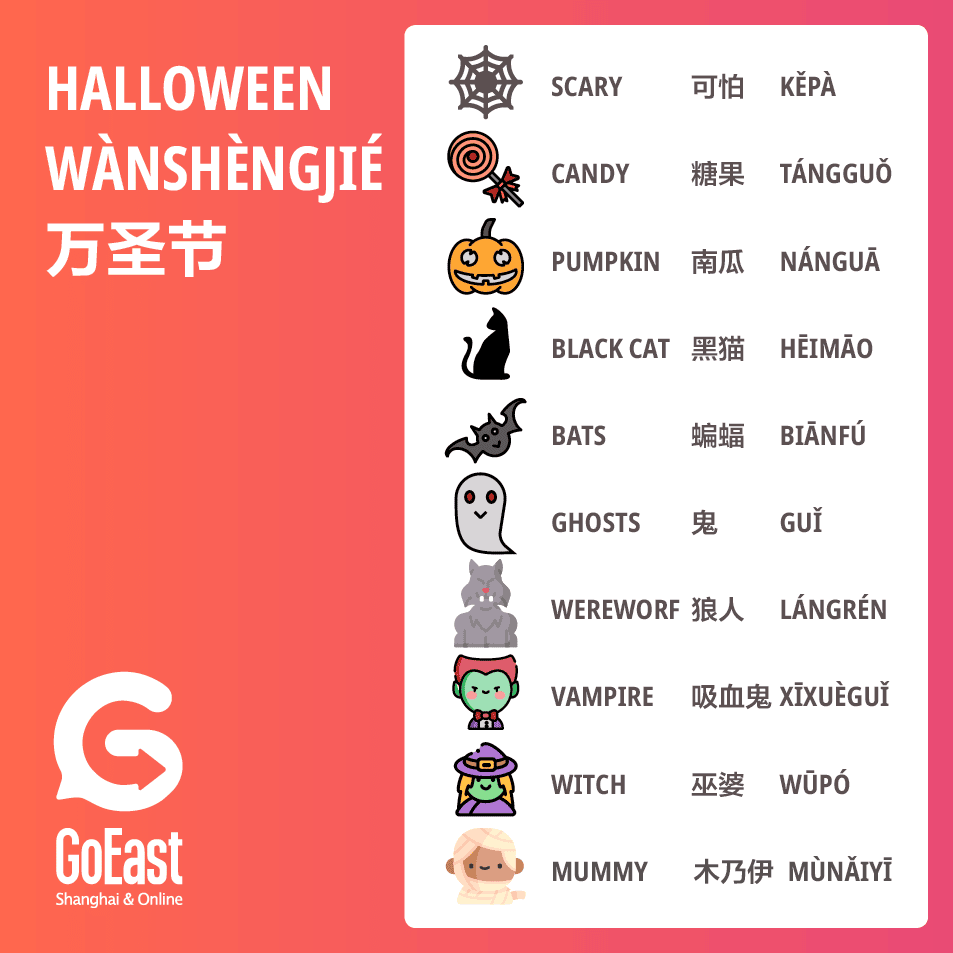
Dressing up for Halloween? Make sure you’re not just 可怕 kěpà (scary) but also linguistically correct.
| English | 汉字 Hànzì | Pīnyīn |
|---|---|---|
| Scary | 可怕 | kě pà |
| Candy | 糖果 | táng guǒ |
| Pumpkin | 南瓜 | nán guā |
| Black cat | 黑猫 | hēi māo |
| Bat | 蝙蝠 | biān fú |
| Ghost | 鬼 | guǐ |
| Vampire | 吸血鬼 | xī xuè guǐ |
| Witch | 巫婆 | wū pó |
| Mummy | 木乃伊 | mù nǎi yī |
Werewolf (game) vocabulary in Chinese
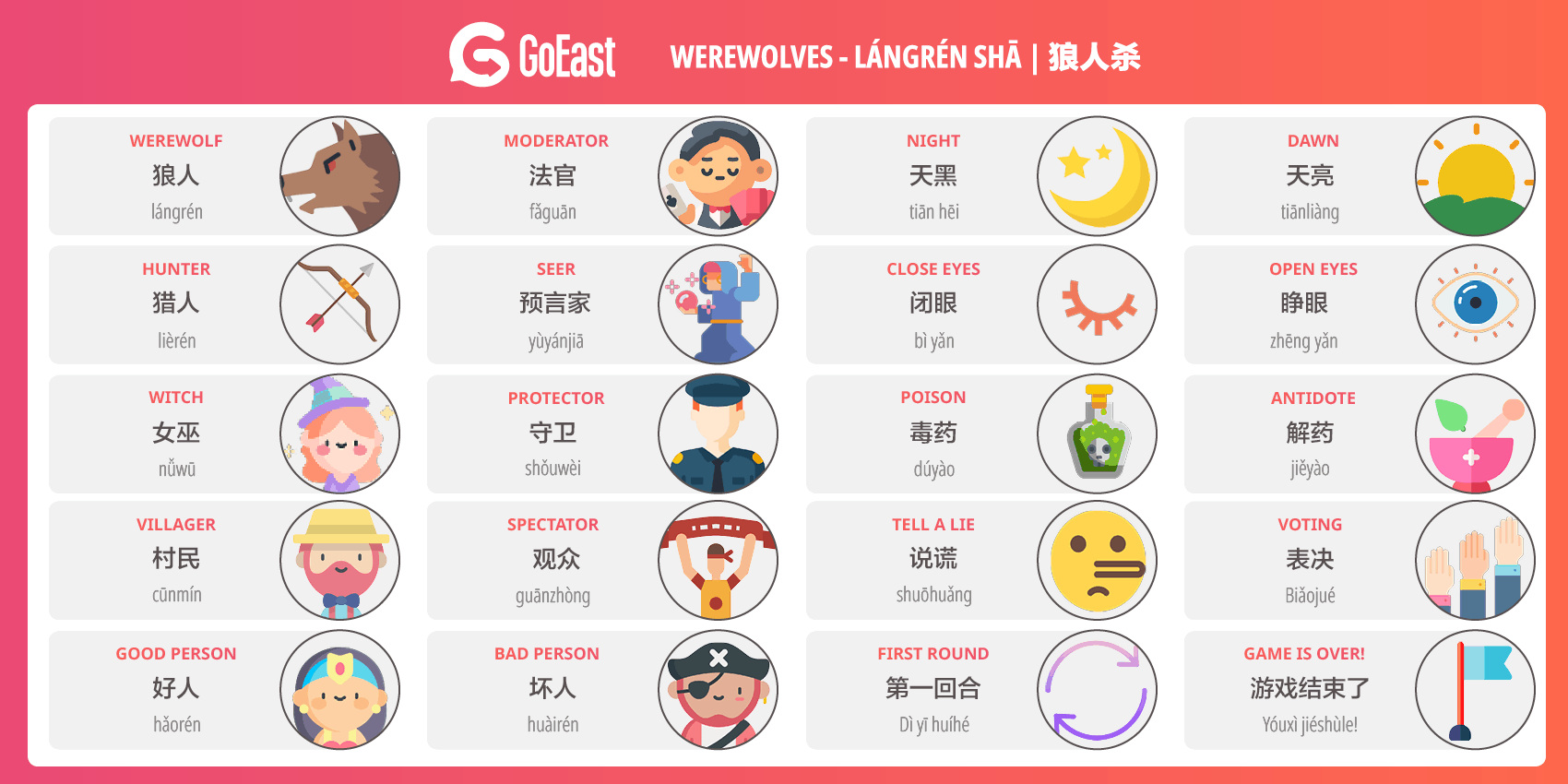
Terms for the party game, which we also play at our online events.
| English | 汉字 Hànzì | Pīnyīn |
|---|---|---|
| Werewolf | 狼人 | láng rén |
| Moderator | 法官 | fǎ guān |
| Seer | 预言家 | yù yán jiā |
| Witch | 女巫 | nǚ wū |
| Hunter | 猎人 | liè rén |
| Guard | 守卫 | shǒu wèi |
| Villager | 村民 | cūn mín |
| Night falls | 天黑 | tiān hēi |
| Dawn breaks | 天亮 | tiān liàng |
| Vote | 表决 | biǎo jué |
Health and illness vocabulary
Useful words for the doctor’s office or talking about getting sick.
| English | 汉字 Hànzì | Pīnyīn |
|---|---|---|
| Virus | 病毒 | bìng dú |
| To have a fever | 发烧 | fā shāo |
| To cough | 咳嗽 | ké sòu |
| Wear a mask | 戴口罩 | dài kǒu zhào |
| Quarantine | 隔离 | gé lí |
| To spread | 传播 | chuán bō |
| To recover | 恢复 | huī fù |
| Difficulty breathing | 呼吸困难 | hū xī kùn nán |
Chinese hotpot vocabulary
Order hotpot like a local. See the full hotpot and food vocabulary article for more.
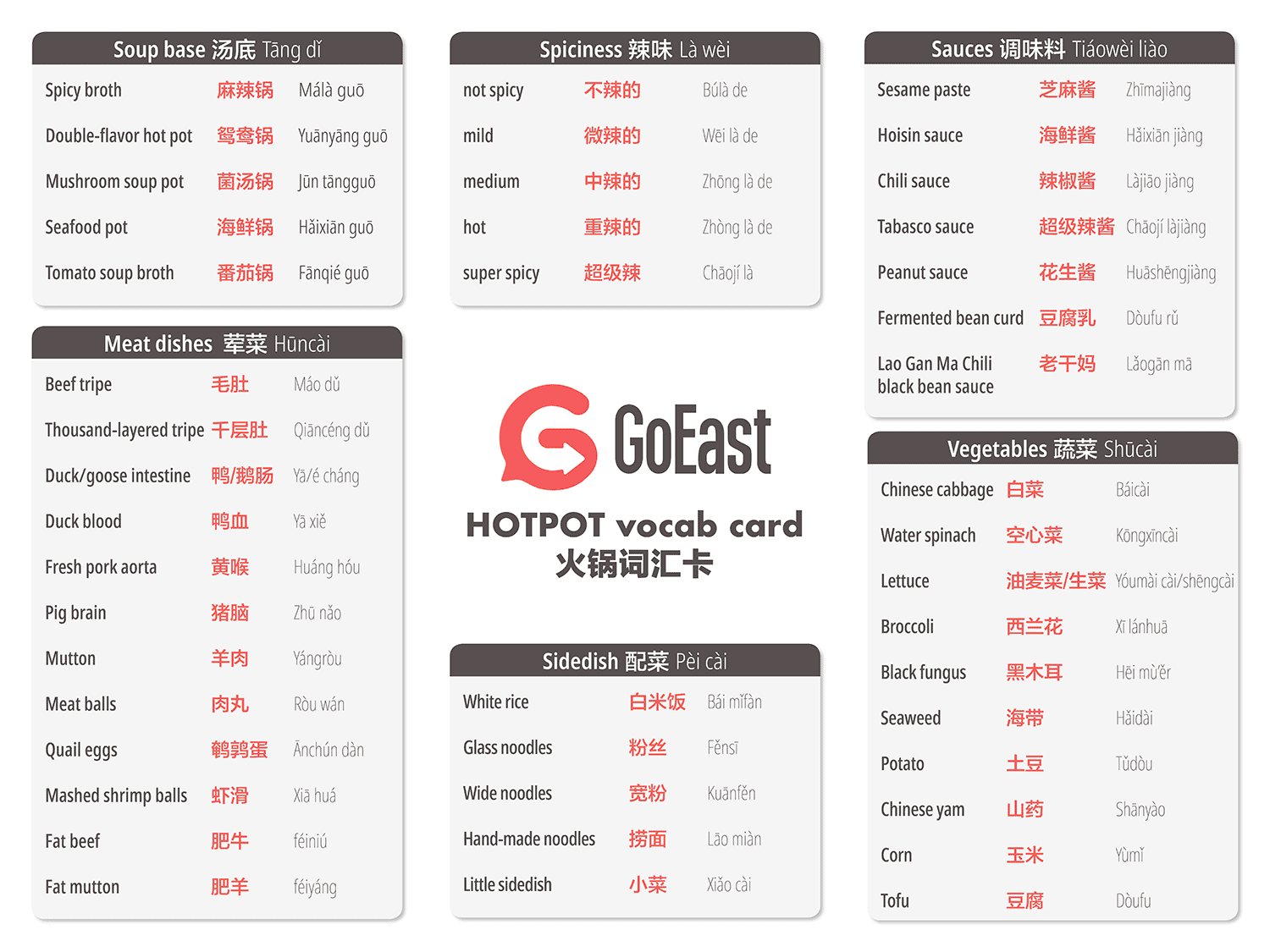
| English | 汉字 Hànzì | Pīnyīn |
|---|---|---|
| Spicy broth | 麻辣锅 | má là guō |
| Split (two-flavor) pot | 鸳鸯锅 | yuān yāng guō |
| Mushroom soup pot | 菌汤锅 | jūn tāng guō |
| Tomato soup broth | 番茄锅 | fān qié guō |
| Not spicy | 不辣的 | bù là de |
| Mild | 微辣的 | wēi là de |
| Sesame paste (dip) | 芝麻酱 | zhī má jiàng |
| Fat beef slices | 肥牛 | féi niú |
| Meatballs | 肉丸 | ròu wán |
| Tofu | 豆腐 | dòu fǔ |
| Chinese cabbage | 白菜 | bái cài |
| Glass noodles | 粉丝 | fěn sī |
| White rice | 白米饭 | bái mǐ fàn |
Football (soccer) vocabulary in Chinese
Cheer along — amicably — in Mandarin.
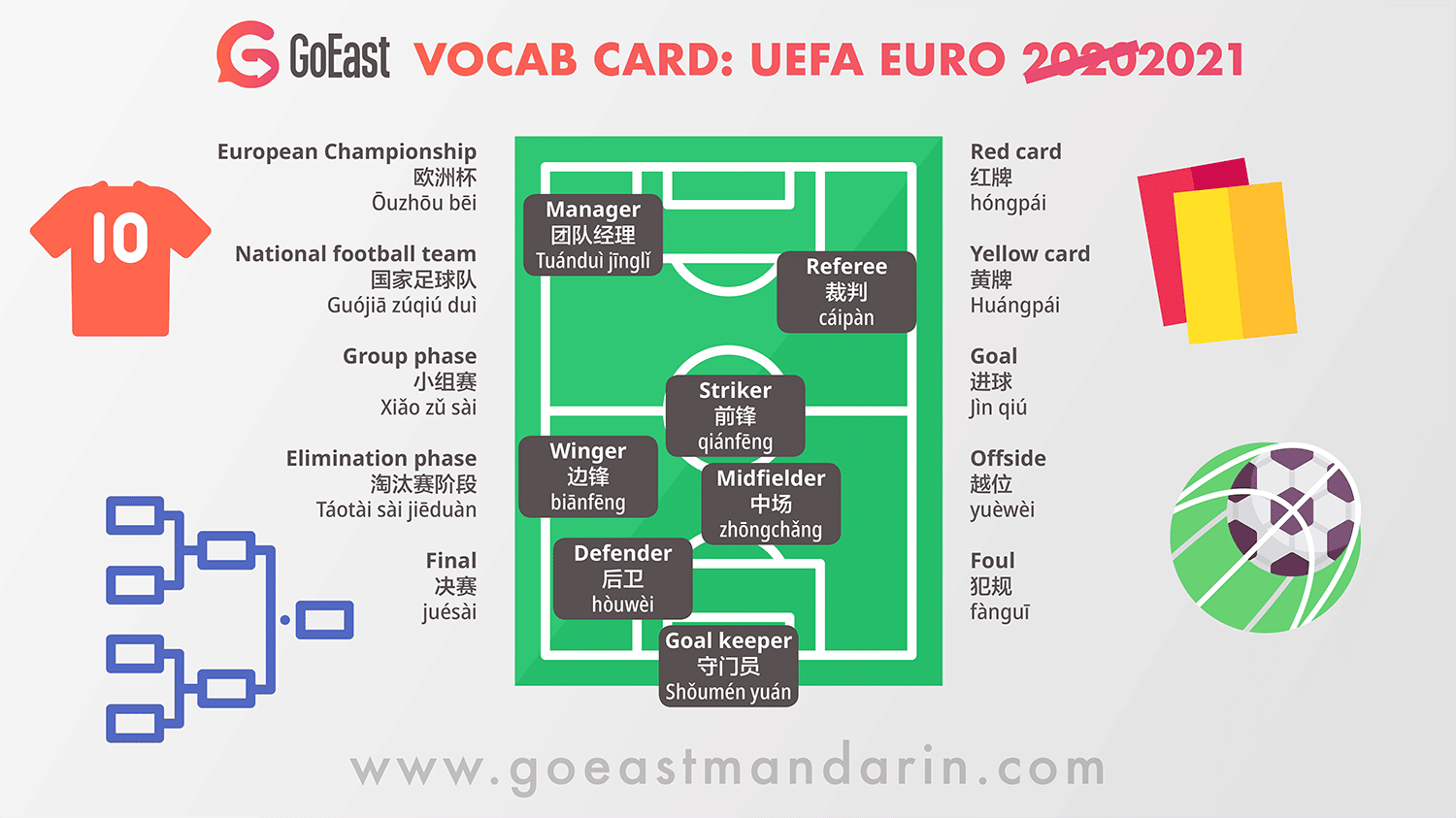
| English | 汉字 Hànzì | Pīnyīn |
|---|---|---|
| Goal | 进球 | jìn qiú |
| Red card | 红牌 | hóng pái |
| Yellow card | 黄牌 | huáng pái |
| Offside | 越位 | yuè wèi |
| Foul | 犯规 | fàn guī |
| Referee | 裁判 | cái pàn |
| Striker | 前锋 | qián fēng |
| Midfielder | 中场 | zhōng chǎng |
| Defender | 后卫 | hòu wèi |
| Goalkeeper | 守门员 | shǒu mén yuán |
| Final | 决赛 | jué sài |
Olympic Games vocabulary in Chinese
Talk about the world’s biggest sports competition with Chinese friends.
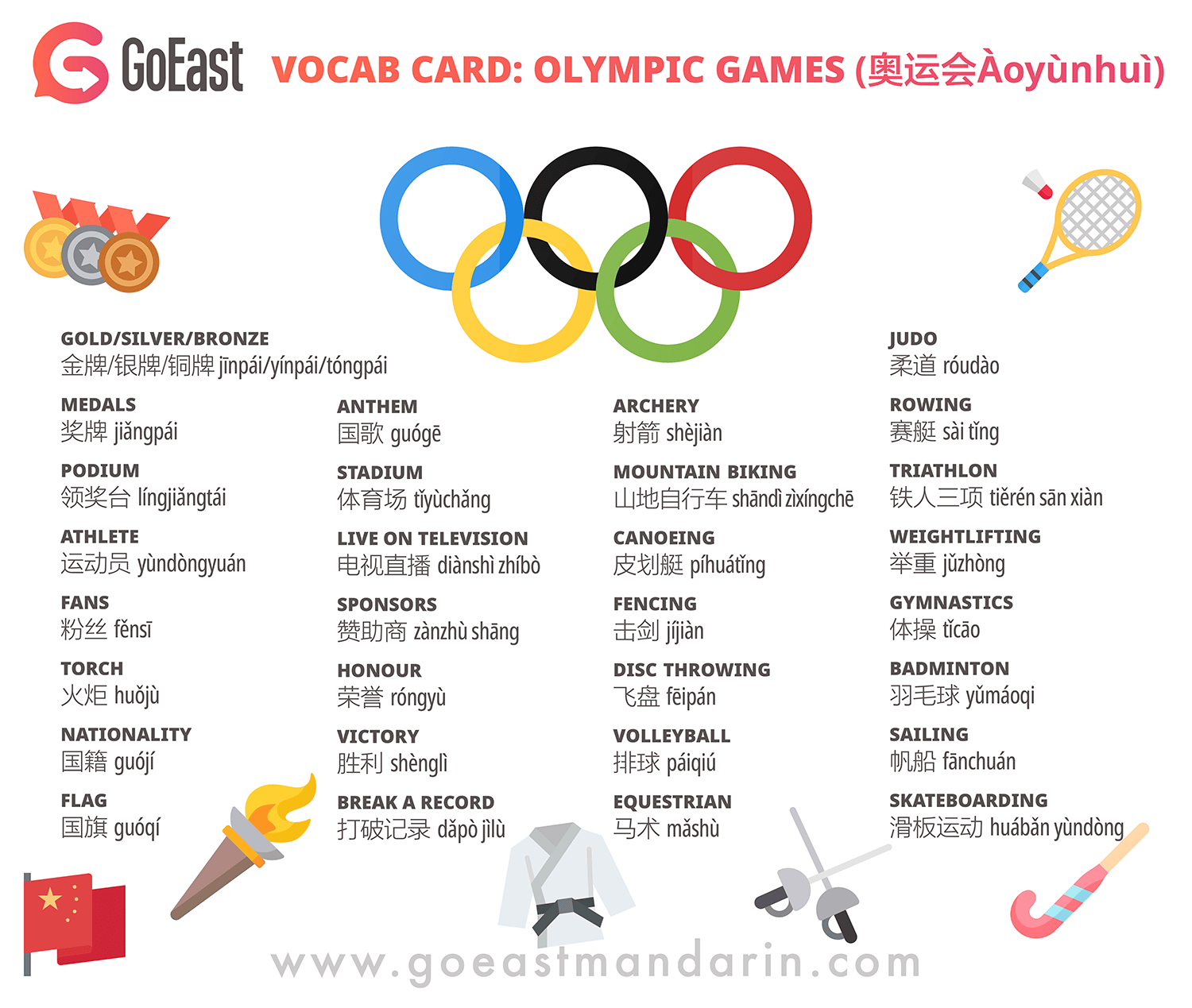
| English | 汉字 Hànzì | Pīnyīn |
|---|---|---|
| Gold / silver / bronze | 金牌 / 银牌 / 铜牌 | jīn pái / yín pái / tóng pái |
| Medal | 奖牌 | jiǎng pái |
| Podium | 领奖台 | lǐng jiǎng tái |
| Athlete | 运动员 | yùn dòng yuán |
| Torch | 火炬 | huǒ jù |
| Stadium | 体育场 | tǐ yù chǎng |
| Break a record | 打破纪录 | dǎ pò jì lù |
| Victory | 胜利 | shèng lì |
| Badminton | 羽毛球 | yǔ máo qiú |
| Gymnastics | 体操 | tǐ cāo |
| Fencing | 击剑 | jī jiàn |
| Weightlifting | 举重 | jǔ zhòng |
How to learn and memorize Chinese vocabulary
The fastest way to grow your Chinese vocabulary isn’t brute-force memorization — it’s a few proven habits. Follow these steps to make new words stick.
- Start with high-frequency words. Master the most common 300 words first (HSK 1–2). They appear constantly, so every review pays off many times over.
- Learn in themed groups. Your brain links related ideas, so a set like the food or family words above is easier to recall than random lists.
- Use spaced repetition. Review each word right before you’d forget it. Flashcard apps with a spaced-repetition system (SRS) schedule this automatically.
- Break words into characters and radicals. Knowing that 电脑 diànnǎo is “electric brain” turns memorization into understanding.
- Put new words in sentences. Don’t just learn 水 shuǐ — say 我要喝水 Wǒ yào hē shuǐ. Words learned in context are recalled in context.
Key takeaways
- About 300 high-frequency words (HSK 1–2) cover most everyday Chinese.
- Many Chinese words are guessable compounds: 电脑 = “electric brain,” 飞机 = “flying machine.”
- Characters are built from roughly 200 radicals — learn the building blocks to decode new characters.
- Learn vocabulary by topic and review with spaced repetition for the best retention.
- Always learn words in example sentences, not in isolation.
Get the full 5,000-word HSK vocabulary list
Build your Chinese vocabulary systematically with our complete HSK list — every word with Hànzì, pinyin, and English — and start with the GoEast HSK 1 course.
Want the full list by email? Leave your address and we’ll send the complete 5,000-word HSK vocabulary list with weekly learning tips (unsubscribe anytime).
Frequently asked questions
How many Chinese words do I need to know to be conversational?
About 300 high-frequency words — roughly HSK levels 1 and 2 — let you handle most everyday conversations. Around 1,200 words (HSK 4) allows you to discuss a wide range of topics with some fluency.
What are the most common Chinese words?
The most common Chinese words include 你好 nǐ hǎo (hello), 谢谢 xièxie (thank you), 是 shì (to be / yes), 我 wǒ (I), 你 nǐ (you), and 好 hǎo (good). These appear in nearly every conversation.
Can you guess the meaning of Chinese words from their characters?
Often, yes. Many Chinese words are compounds whose meaning follows from their parts: 电脑 diànnǎo is “electric brain” (computer), 飞机 fēijī is “flying machine” (airplane), and 火车 huǒchē is “fire vehicle” (train).
What’s the difference between a Chinese character and a Chinese word?
A character (汉字 Hànzì) is a single written unit, while a word is one or more characters that carry a meaning together. For example, 电 (electric) and 脑 (brain) are two characters that form the single word 电脑 (computer).
How do I memorize Chinese vocabulary quickly?
Focus on high-frequency words first, group them by topic, review them with spaced repetition, and learn each word inside an example sentence rather than in isolation. Breaking words into their characters and radicals also speeds up memorization.
How many words are in the HSK exam?
The HSK levels build cumulatively: 150 words at HSK 1, 300 at HSK 2, 600 at HSK 3, 1,200 at HSK 4, 2,500 at HSK 5, and 5,000 at HSK 6.
What is the best way to learn Chinese vocabulary by topic?
Pick a theme you’ll actually use — food, family, work, or a hobby — and learn 8–15 related words together with their pinyin. Themed sets are easier to recall because your brain links related ideas, and you can immediately use them in real conversations.