Love in Two Languages: How Joe and Jessica Made Chinese a Shared Project
He’s a white American PA from Minnesota. She’s a Chinese-American PA who grew up between cultures. A wedding vow in Chinese started as a romantic gesture—and turned into a long-term journey of learning, connection, and family.
A wedding vow in Chinese (and the one person he needed to impress)
On their wedding day in July 2023, Joe Miller stood up in front of family and friends and switched, mid-vow, into Chinese.
| “我承诺我会继续学习你的文化和中文(wǒ chéngnuò wǒ huì jìxù xuéxí nǐ de wénhuà hé zhōngwén),” he told Jessica. “I promise I’ll keep learning your culture and your language.” |
He had practiced that line for months—recording himself, sending clips to a Chinese coworker’s mom, getting tone corrections back again and again. When he finally said it on stage, most people didn’t really understand it. Except one person: Jessica’s father understood every word and started clapping loudly.
Later, Jessica’s mom quietly admitted she hadn’t caught the meaning. She asked to read the script herself. “It is nice,” she commented afterwards—not an easy compliment from a Chinese mom.
It was sweet. It was brave. And for Joe, it wasn’t just performance. It was a promise he fully intended to keep.
“I didn’t want to be just a bystander,” Joe says. “I wanted to be part of her culture.”
And if there’s one thing to know about Joe: once he sets a goal, it becomes a race. He doesn’t just want to “learn some Chinese.” In his ideal world, he’ll one day speak it better than Jessica.

From apps and frustration to: “Let’s do this properly”
Joe grew up in Minnesota; Jessica grew up in California with Shanghainese parents. At home, Jessica’s world was very Chinese—food, TV, WeChat, relatives. But like many heritage kids, she never had a clear, long-term path to really master the language.
“I feel very Chinese in the US,” she says. “But in China, I don’t feel fully Chinese. I’m somewhere in between.”
Both trained as PAs at Yale, graduated in 2020, and started working in Washington State in 2021. Around that time, Joe started trying to teach himself Chinese with apps—Duolingo, HelloChinese, Mango, YouTube videos.
He lasted a few months.
Jessica watched this and had a very heritage-kid reaction: “I told him: Chinese isn’t a language you can really learn alone on your phone. You need a real teacher to correct you.”
Still, Joe pulled off the vows. Chinese went back to the background—until their first trip to China together in April 2024.
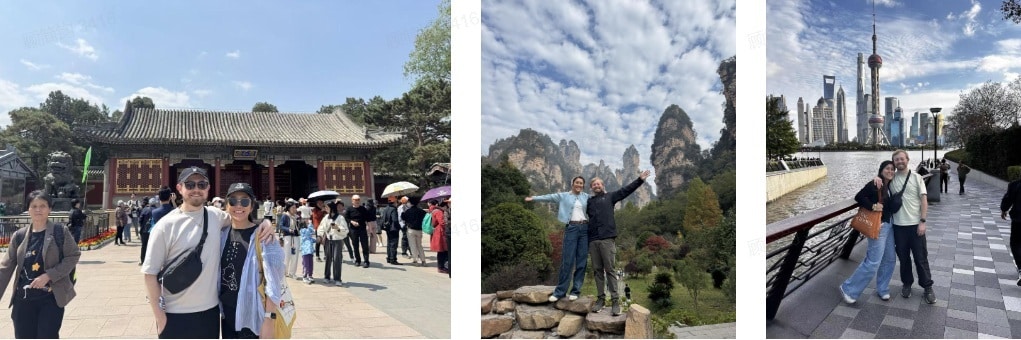
They visited Shanghai and Beijing with Jessica’s mom. Joe loved it immediately: the food, the spinning tables, the family banquets, the speed of the city. But both of them also hit limits.
Jessica noticed painful gaps when trying to explain her PA job or describe something specific to relatives. Joe realized that the handful of phrases and app vocabulary he had wasn’t enough for real conversations.
“Almost the first day back in US,” Joe says, “we both felt it. If we’re serious about Chinese, we need to do this properly.”
Finding GoEast—and being put back at HSK 1
Back in the US, they started searching. Local universities were too far or didn’t fit their shifts. They didn’t want another “all-app” attempt.
Jessica found GoEast through a learner’s blog, liked the honesty and the academic structure behind it, and booked an assessment.
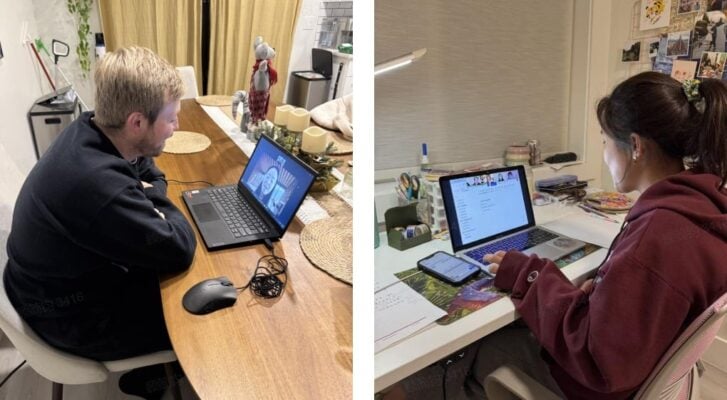
She did an intake with a language consultant, took a trial class, and quickly signed up for a long-term online package. At the same time, Joe took GoEast’s placement.
After months of apps, he was sure he’d be at least mid-HSK 1.
GoEast placed him at the very beginning of HSK 1.
“They were very kind about it,” he laughs, “but it was clear: if I wanted a solid foundation, I needed to start from Lesson 1.”
In hindsight, he’s grateful. The “reset” meant tones, pinyin, and basic patterns were built properly—not on top of scattered app habits.
Group vs. 1-on-1: two brains, two paths
Money and quality learning were real factors at the start.
“We both wanted to invest in our learning,” Jessica says, “but we also have loans and real-life expenses. Group classes were more affordable, so that’s how we first looked at GoEast.”
They quickly discovered something important about GoEast’s group model:
- Class sizes stay very small.
- If there’s only one student at that level and time, the class still runs—effectively as a 1-on-1, at group pricing.
“Many weeks it was just me and Annie laoshi,” Joe says. “It felt like private tutoring, but we were paying group rates.”
Over time, they each gravitated toward different formats:
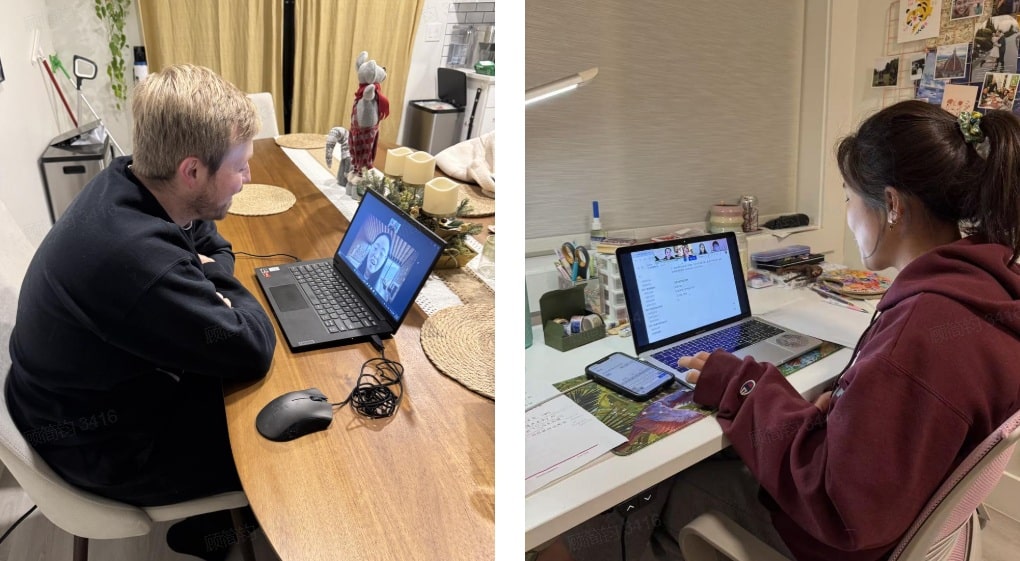
Jessica → Group classes (structure + momentum)
Jessica’s schedule runs later; she often comes home tired after a full day of patients. For her, the most important thing is showing up, not doing perfect homework.
“I treat homework as a bonus,” she says. “If I have energy, I do it. If not, I still attend class and learn a lot.”
She stayed in GoEast’s structured group track, moving steadily through levels over about 20 months. Group classes give her:
- A clear curriculum and long-term progression
- Exposure to classmates from around the world
- Listening practice to real, varied Mandarin
- A space where low-energy days still count as progress
Learn more about GoEast group learning here:
Chinese Group Classes.
Joe → 1-on-1 (speed + questions)
Joe finishes work earlier and has more afternoon energy for study. “If there’s an exercise, I want to do all of it,” he says. “And then ask extra questions.”
At first he was in Annie’s “group,” but often as the only student. When a new classmate was scheduled to join, Joe suddenly realized how much he loved the free-flow 1-on-1 style. He even admits he over-prepared that week so hard that the newcomer decided the pace wasn’t for them.
It wasn’t personal. It’s just who Joe is: if there’s a game, he plays to win. Chinese class is no exception.
After that, he officially upgraded to 1-on-1, twice a week.
If your schedule is irregular or you want a faster, more tailored path, here’s the 1-on-1 option:
Online Private Chinese Lessons.
What their paths show (for couples learning Chinese together)
- If you’re budget-sensitive and want structure, small group classes can be a great fit—especially when a class still runs with one student.
- If you’re highly driven, question-heavy, and have more time, 1-on-1 can unlock faster progress once you’ve committed for the long term.
In both cases, what they valued most was the same: real teachers, a clear curriculum, and flexibility once they understood what worked best.
A “secret language” at home—and in public
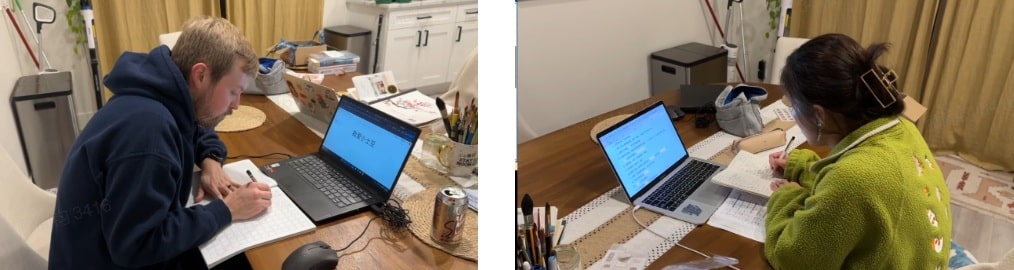
Chinese is no longer something they only use in class.
At home, Joe often asks Jessica to speak to him in Mandarin, just to test comprehension. When he writes homework, he sometimes checks with her first—but intentionally doesn’t write down answers that are too advanced, saving those for his teacher to introduce at the right level.
Jessica, in turn, feels her own Chinese sharpen when she has to explain why something “sounds wrong,” not just correct it by instinct.
Out in public, Chinese has become their “secret channel.”
“When we don’t want people around us to understand,” Jessica says, “especially if they’re English-speakers, we switch to Chinese.”
It’s used for quick comments in the supermarket, quiet notes at a restaurant table, or logistical whispers like “我要放屁” that feel more private in Mandarin.
Professionally, Chinese is starting to matter too. Their area doesn’t have a huge Mandarin-speaking population, but Jessica has had several Mandarin-speaking patients recently. She starts in English, then shifts parts of the conversation into Chinese when she sees it helps them relax.
“You can feel people open up when they hear their own language,” Joe says. Long term, both would like to bring more medical Chinese into their work.
Back to Shanghai—and a useful reality check
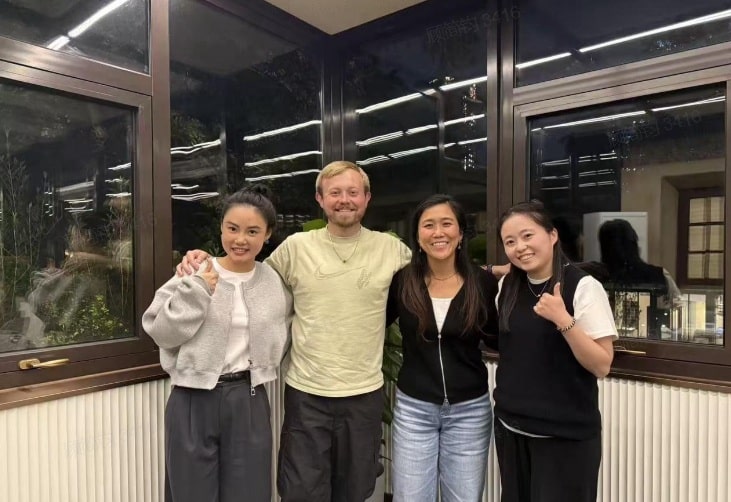
In November 2025, they returned to China with Jessica’s parents and visited GoEast’s Shanghai campus. They finally met their teachers and the team in person, had dinner together, and asked all the non-textbook questions about life and work in the city.
For Jessica, talking with Chinese peers her age about burnout, career choices, and everyday life in Shanghai made the language feel less like “heritage” and more like a fully shared space.
For Joe, the trip was also humbling. Before going, he imagined chatting easily with everyone. On the ground, he realized he understood two people perfectly: his teacher and his wife. Everyone else—Jessica’s dad with his Shanghainese-influenced Mandarin, waiters, drivers—was much harder.
“I’d get stuck on one word and miss the rest,” he says. “It was a good reality check.”
| He started saying, half-jokingly: “我说中文说得还行,但是我听你的中文不好。” “I speak Chinese okay, but I don’t listen to your Chinese very well.” |
By the end of the trip, longer conversations—like a 30-minute chat with a driver in Zhangjiajie—were already easier. But the message was clear: the journey from “good classroom Chinese” to “real-world listening” takes time.
For someone as competitive as Joe, it didn’t discourage him—it just gave him a clearer finish line to run toward.
Looking ahead: less resolutions, more rhythm
When you ask about their “New Year’s resolutions” for Chinese, neither of them talks about passing a specific HSK level.
Joe’s list is simple:
- Keep a steady rhythm: 2–3 years of continued study, not big sprints and crashes
- Listen more—to different accents, not only teachers
- Use more Chinese in daily life, not just in class
Jessica’s focus is just as practical:
- Deepen vocabulary retention, especially words she “knows she’s seen” but can’t recall under pressure
- Build enough digital Chinese for future trips: booking trains, ordering milk tea, shopping online
- Gradually expand into medical Chinese so she can explain more to patients
What matters most isn’t a test date. It’s continuity.
“I’d love for our home to be half Chinese, half English,” Joe says. “We’re not there yet. But that’s the direction.”
From the outside, it’s pretty clear Joe would love to overtake Jessica in Chinese one day—but it doesn’t look like she’ll let that happen too easily. Their friendly competition has quietly become part of the fun, and part of what keeps both of them moving forward.
Learning each other’s language, one class at a time
From the outside, Joe and Jessica’s story is easy to summarize: two Yale-trained PAs, busy jobs, online Chinese classes.
But the real story is made of small, human things:
- A vow in Chinese that made one Shanghainese father clap with pride
- A heritage daughter who no longer wants to “half-understand” her own culture
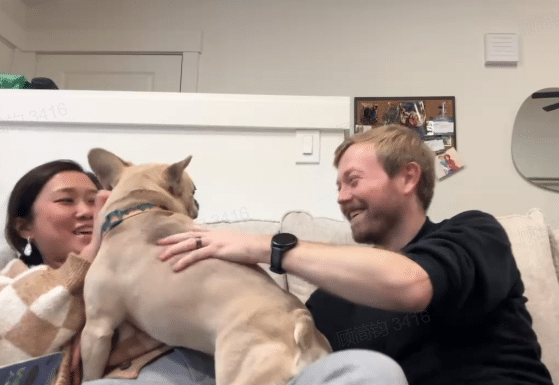
- A family dog called 小土豆 listening to commands in two languages
Chinese didn’t just give them more words. It gave them another way to keep a promise: learning each other’s language not just once, on a wedding day—but week after week, on Zoom and in real life, one lesson, one conversation, one inside joke at a time.