

Two Years for One Big Bet: Why a Saudi Economic Analyst Is Seriously Learning Chinese
Abdulrahman is an Economic Analyst in Riyadh. In February 2025 he started Chinese from near-zero with GoEast.
Ten months later, he can hold full conversations in Chinese — because he’s treating the language like a 2–3 year career investment, not a hobby.
A long-term view, not a quick win
Abdulrahman studied Economics and Statistics and now works as an Economic Analyst in Saudi Arabia. His world is data, policy, and long-term trends.
Chinese, for him, is part of that long-term picture: China’s role in the global economy, growing links with the Gulf region,
and a future in which real understanding — not just translation — creates opportunity.
He doesn’t need Chinese for tomorrow’s meeting. He needs it for the next 20–30 years of his career.

Why Chinese, Why Now?
Abdulrahman doesn’t fit the stereotype of someone who “falls into” a language. His reasons are deliberate.
When he talks about Chinese, three themes come back again and again.
1) A Strategic Skill for His Career
Abdulrahman works as an Economic Analyst in Riyadh. His background — Economics, Statistics and Political Science — has already put him in a strong analytical role.
But when he looks at the future of data, AI, and global trade, one pattern is obvious to him: China matters.
| “In my job, I look at numbers and trends all the time,” he says. “It’s very clear that China will keep playing a big role. I don’t just want to read about that from the outside — I want to be able to speak to people, read original sources, and maybe one day work on China-related projects.” |
Chinese is not an abstract interest for him. It’s a concrete way to stand out in a field where many people share similar degrees and skills.
2) A Deep Love of History
Abdulrahman has always been fascinated by world history. Since childhood, he has read widely — across regions, periods, and civilizations —
believing that history offers lessons about how societies evolve and why decisions shape the world the way they do.
China holds a special place in that curiosity. With its long and complex history spanning thousands of years, it offers a depth few civilizations can match.
| “When you study Chinese history,” he says, “you start asking why things happened the way they did — why certain paths were chosen, and how those choices still affect the present.” |
For Abdulrahman, learning Chinese is a way to get closer to those answers — with access not just to events, but to perspectives.
3) A Love of Learning Languages
There is also a more personal motivation: Abdulrahman loves learning languages.
He already speaks four — Arabic, English, Spanish, and now Mandarin — and he doesn’t see Chinese as the end of that journey.
| “For me, learning a language always needs a plan,” he says. “You have to invest time and energy into it.” |
Being able to speak freely — to communicate without barriers — is what turns a language from a subject into a living skill.

Ten Months of Consistency
A lot of people like the idea of learning Chinese. Abdulrahman likes the routine.
From the beginning, he worked with GoEast’s language consultant to design something strict but realistic:
| “My teacher is very structured but also encouraging,” Abdulrahman says. “She doesn’t let me get lazy with tones or grammar, but she also pushes me to speak about real things — my job, my plans, my opinions.” |
Ten months later, the results are obvious: he can hold full conversations in Chinese, express complex ideas in simpler words,
and stay in Chinese for long stretches without falling back to English.
From Screen to Shanghai
In October 2025, halfway through his first year, Abdulrahman decided it was time to test the language in real life.
He traveled to China to immerse himself and see how far his Chinese could really take him.
Almost overnight, the vocabulary lists from his textbooks turned into street signs, coffee orders, and metro announcements.
He ordered food, navigated public transportation, checked into hotels, and held everyday conversations with locals — entirely in Mandarin.
| “That’s when I thought, ‘OK, this is starting to work. I can actually live a little in this language.’” |
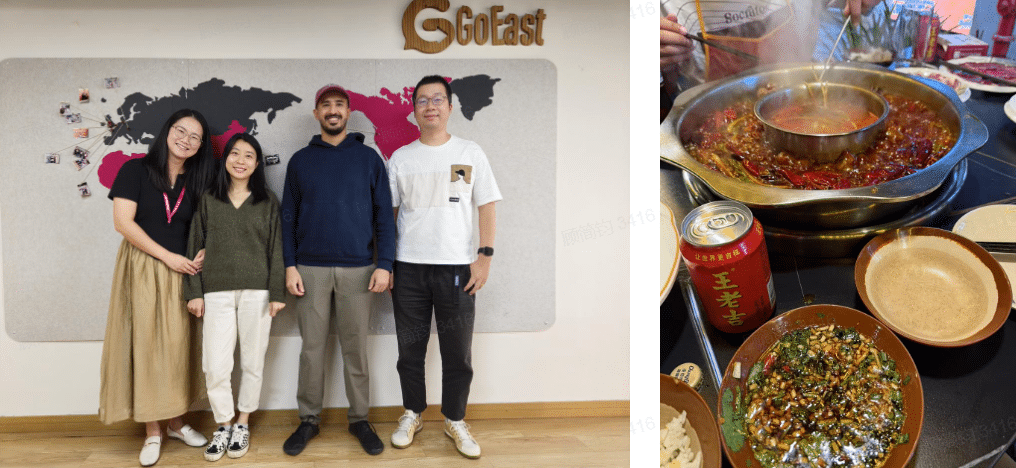
During the trip, Abdulrahman also visited GoEast and finally met the team in person, bringing gifts with him.
The moment felt real — a meaningful milestone in his learning journey.

Apply Chinese to the Office
Abdulrahman didn’t leave his Chinese in the classroom. Back at work, he began sharing insights he had read in Chinese sources with his manager —
information that proved genuinely useful.
It wasn’t about an immediate title change or promotion. But at this stage, something equally important was happening:
he was being recognized as someone actively building a high-value skill. In a competitive field, that kind of perception matters.
A 2–3-Year Project, Not a 30-Day Challenge
Abdulrahman is very clear about timelines. He doesn’t expect fluency in a few months. He sees Chinese as a serious, multi-year investment.
| “I think two or three years of focused effort can take you very far,” he says. “I’m only ten months in. I’m happy with the progress, but I also know this is just the beginning.” |
That mindset shapes how he learns:
|
For Abdulrahman, Chinese is more than a language he’s learning today. It’s a tool for the future he’s building —
one where understanding China, its people, and its perspective becomes a professional advantage.
Related reading & resources
If you’re learning Chinese for work, start with practical vocabulary you can use immediately:
Business Chinese Vocabulary List
And if you enjoy learner stories with a long-term mindset, you may also like:
It’s Never Too Late to Learn Chinese (Lili’s Story)