
How Long to Learn Mandarin Chinese? Levels & Timeline 2026
Mandarin Chinese has a reputation as one of the hardest languages for English speakers — and the workload is real. But the timeline is more predictable than most people expect, and you start using Chinese long before you are “fluent.” This guide gives realistic, level-by-level timelines for 2026 learners, built on official FSI estimates, the new HSK 3.0 system, and GoEast’s experience teaching Mandarin since 2012.
Quick answerFor an English-speaking adult studying consistently, it takes about 4–6 months to hold basic conversations, 1–2 years to reach a solid intermediate level (around HSK 3–4 / new Bands 3–4), and 3–5 years to reach working fluency (HSK 5–6 / Bands 5–6). The U.S. Foreign Service Institute estimates roughly 2,200 study hours for strong professional proficiency — about 4+ years at 10 hours a week, or 3–3.5× longer than Spanish or French. GoEast’s own teaching data breaks this down further by goal — from ~500 hours for everyday conversation up to 2,300+ hours for academic-level Chinese — see the breakdown below.
The timeline at a glance
Here is the short version for a typical adult learner (native English speaker) studying 5–10 hours a week with a mix of lessons and self-study:
| Goal | Typical time | Roughly equals |
|---|---|---|
| Basic conversation (survival) | ~4–6 months | Old HSK 2 · new Bands 1–2 |
| Lower-intermediate | ~1–1.5 years | Old HSK 3 · new Band 3 |
| Working fluency | ~3–4 years | Old HSK 5–6 · new Bands 4–6 |
| Near-native / academic | 5+ years | New HSK 7–9 |
These ranges assume steady practice across all four skills — listening, speaking, reading and writing — over several years. Study full-time (in China or intensively online) and you progress faster; a few scattered hours a week and it takes longer. The good news: you can use Mandarin in real life from month one.
How long it takes with GoEast, by goal
At GoEast Mandarin we’ve taught Chinese since 2012, and our own data across thousands of adult learners gives a goal-based way to plan your timeline, alongside the FSI and HSK benchmarks in this guide. Instead of one finish line called “fluent,” we track cumulative study hours against three real-world goals: everyday life, the workplace, and advanced or academic use.
| Goal | Cumulative hours | What you can do |
|---|---|---|
| Everyday life communication (生活中文 shēnghuó zhōngwén) | ~500–600 hours | Introduce yourself and make small talk, order food, shop, travel, and handle common daily situations in Chinese |
| Workplace communication (职场中文 zhíchǎng zhōngwén) | ~1,100–1,200 hours | Take part in meetings and work discussions, communicate naturally with Chinese colleagues or partners, and handle more specialized professional topics |
| Advanced / academic communication (学术中文 xuéshù zhōngwén) | ~2,300–2,500 hours | Discuss social and cultural issues, specialized professional content, and academic research topics |
These cumulative-hour ranges come from real learner outcomes rather than an idealized study plan, so they run higher than the “months at 5–10 hrs/week” estimate above — actual progress includes review, plateaus and weeks that don’t go as planned. Cumulative hours turn out to be a more honest predictor of where you’ll land than calendar time alone.
At GoEast Mandarin we structure courses into 6 levels across 10 courses, each roughly 45 lesson hours, with self-study on top. A concrete picture: study 2–3 lessons a week and follow the homework plan, and you can complete Beginner + Elementary (four course levels) in about 9–12 months and reach a stable conversational level you won’t easily lose.
For learners who want to reach intermediate (HSK 3–4 range / Bands 3–4) faster, we suggest aiming for at least 300 hours of lessons plus a similar amount of self-study — done intensively in Shanghai or more gradually with online classes from Europe, the Americas or elsewhere. Our teachers already teach with HSK 3.0 vocabulary and skills in mind, so your time investment matches how proficiency is measured in 2026 and beyond.
Ready to start this fall?
GoEast’s online Fall Chinese classes follow the same 45-hour, 6-level course structure above, with new sections starting each semester — a natural next step from reading about timelines to actually starting one.
Learning a brand-new language as an adult isn’t easy — but persistence, good methods and good instruction get you there. 好好学习,加油! (Hǎohǎo xuéxí, jiāyóu! — Study hard, you’ve got this!)
Mandarin levels explained: beginner to advanced
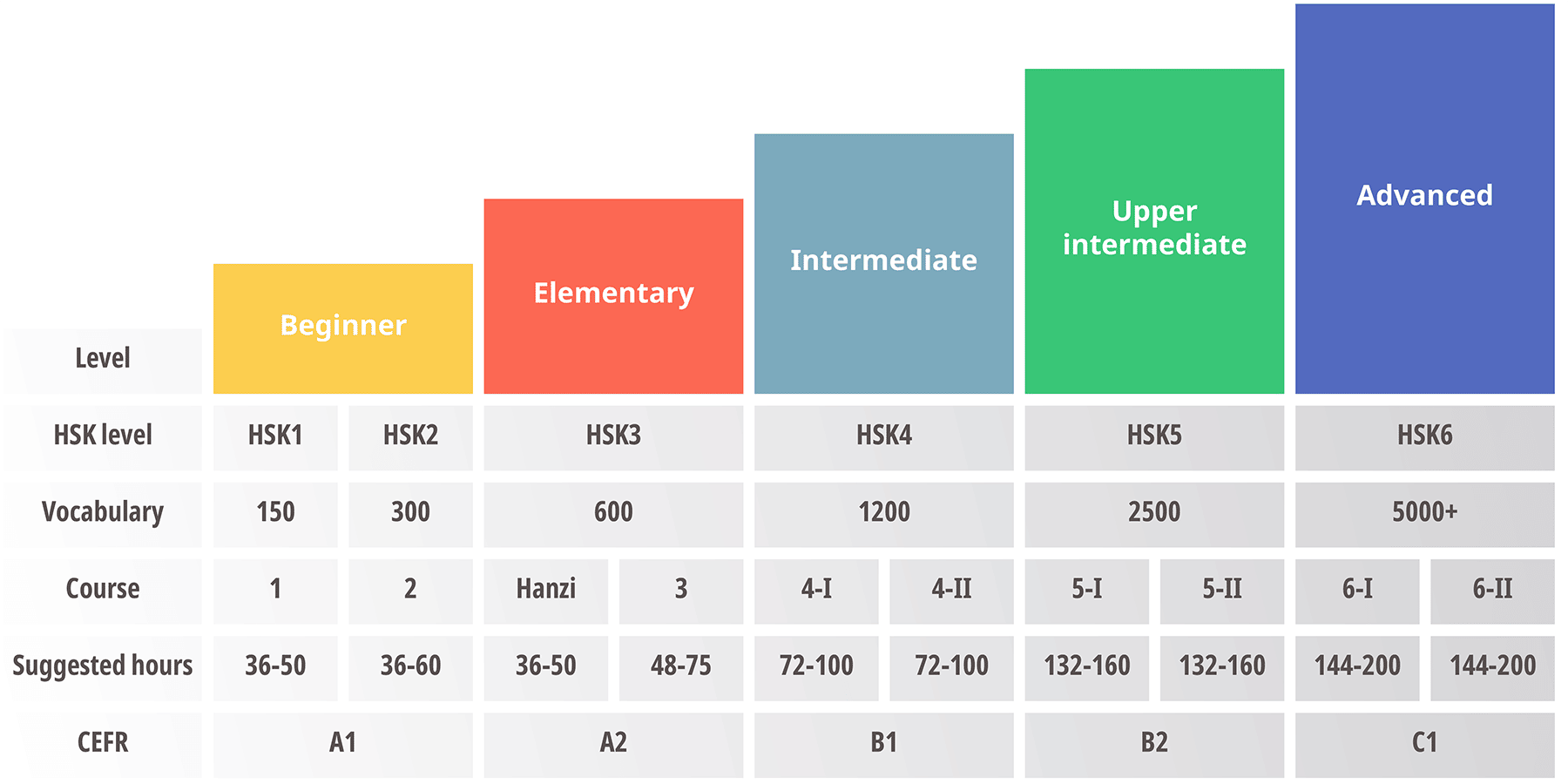
“Mandarin levels” usually map to two reference systems: the HSK (China’s official proficiency test) and the CEFR (the European framework used for most languages). The table below lines them up so you can see where you are, what you can do at each stage, and roughly how long it takes to get there.
| Level | Old HSK | HSK 3.0 band | CEFR (approx.) | Words | What you can do | Typical time* |
|---|---|---|---|---|---|---|
| Beginner | HSK 1–2 | Bands 1–2 | A1–A2 | ~500–1,300 | Greetings, self-introduction, ordering food, basic survival tasks | ~4–6 months |
| Lower-intermediate | HSK 3 | Band 3 | A2–B1 | ~2,200 | Everyday conversations, simple texts, handling travel in Chinese | ~1–1.5 years |
| Intermediate | HSK 4–5 | Bands 4–5 | B1–B2 | ~3,200–4,300 | Discuss work and opinions, follow shows with effort, read articles | ~2–3 years |
| Advanced | HSK 6 | Band 6 | B2–C1 | ~5,500 | Fluent on abstract topics, read newspapers and essays, write reports | ~3–5 years |
| Near-native | — | Bands 7–9 | C1–C2 | ~11,000 | Academic and professional Chinese, literary texts, near-native use | 5+ years |
*Time-to-reach assumes consistent part-time study (5–10 hours/week). The HSK–CEFR mapping is a rough orientation, not an official one-to-one match: Hanban’s claimed alignment is widely disputed, and many institutions place old HSK 6 around CEFR B2–C1 rather than C2. Use the “what you can do” column as the more honest guide. For the full breakdown of the new system, see GoEast’s guide to the new HSK levels (updated 2026).
How many hours does the FSI say it takes?
The clearest research-backed answer comes from the Foreign Service Institute (FSI), which trains U.S. diplomats and ranks languages by how long English speakers need to learn them. Mandarin sits in the hardest tier — the “super-hard” group, alongside Arabic, Japanese and Korean.
The FSI estimate, front and centre:
~2,200 class hours (about 88 weeks of intensive full-time study) to reach strong professional proficiency in Mandarin for a typical English speaker.
That is roughly 3 to 3.5 times longer than a Category I language like Spanish or French (around 600–750 hours). If you are not a full-time diplomatic student, you simply spread those hours out:
| Study pace | Time to ~2,200 hours |
|---|---|
| Full-time intensive (~25 hrs/week) | ~2 years |
| 10 hours/week | ~4+ years |
| 5 hours/week | ~8+ years |
That may sound long, but remember you hit useful milestones along the way — ordering food, small talk, reading social media, working partly in Chinese — long before the 2,200-hour mark. The charts below show how many weeks it takes learners of different aptitudes to reach each FSI level, for an easy language versus Chinese.
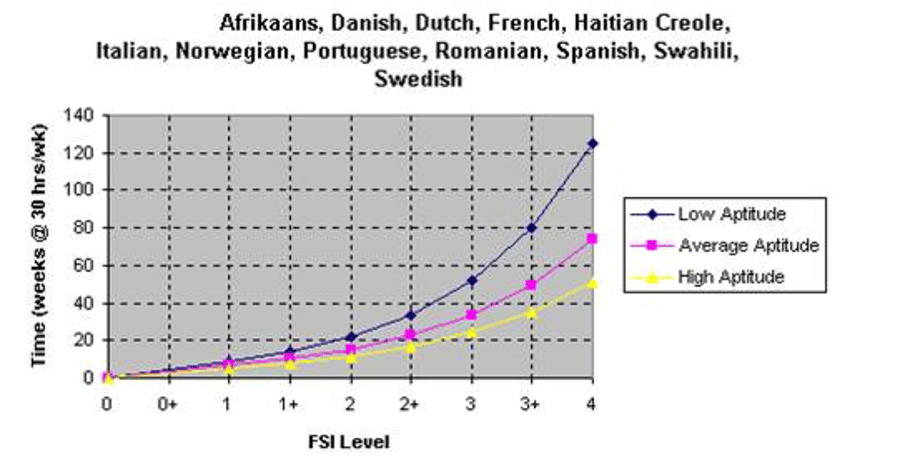
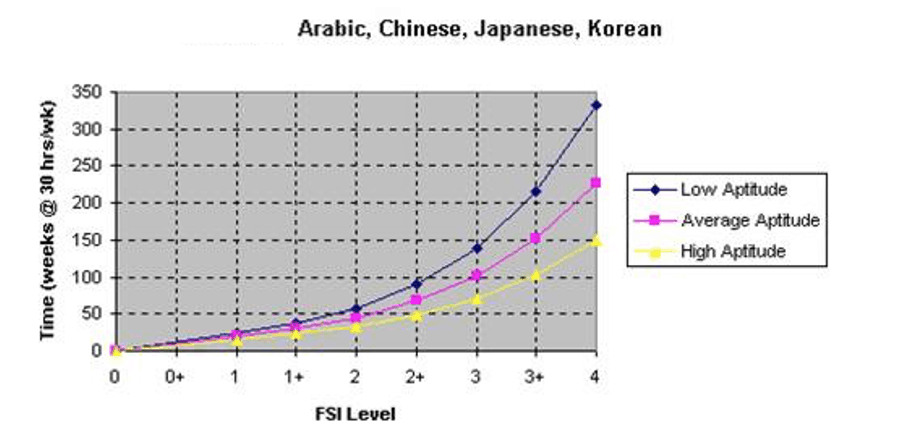
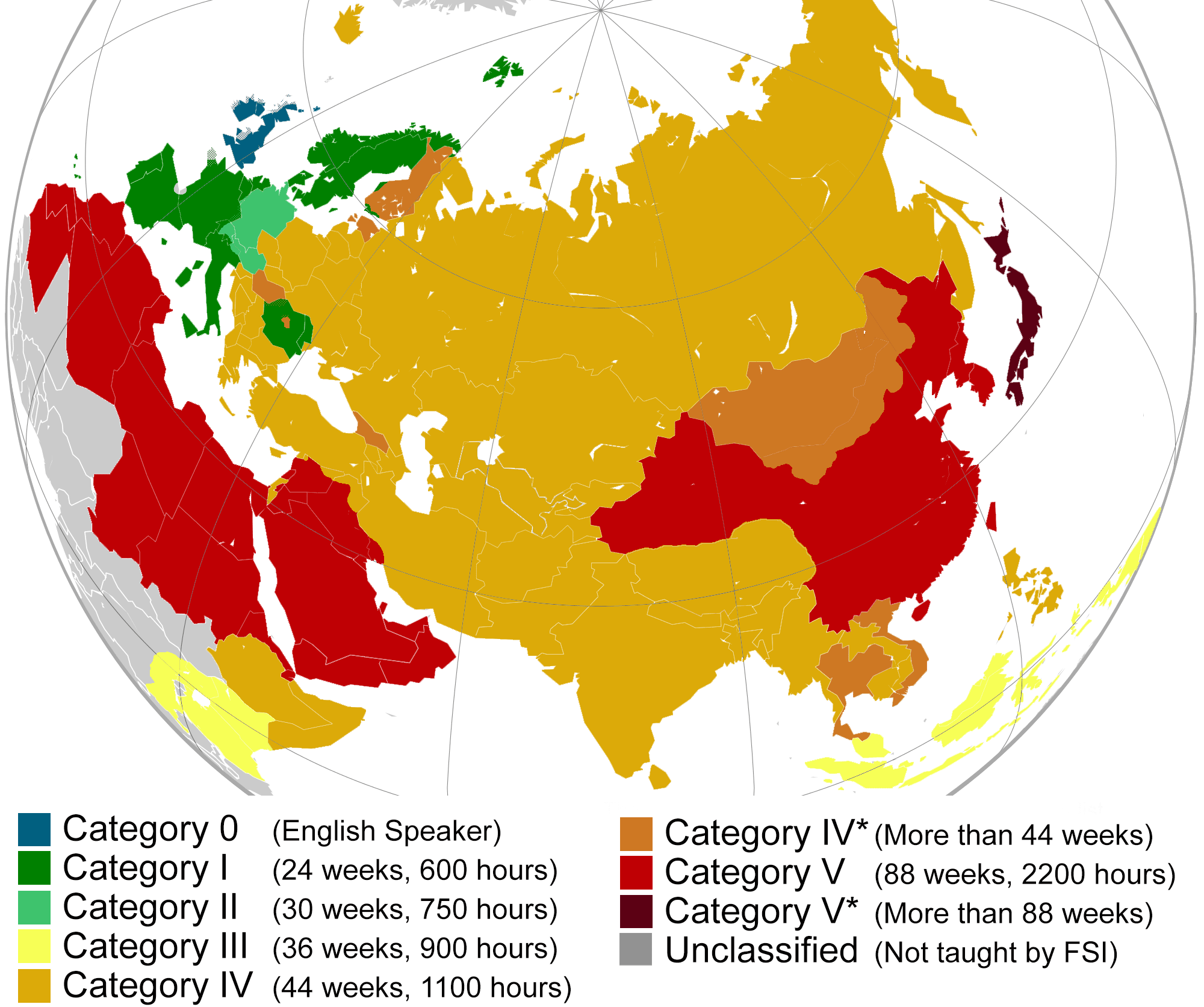
A learner of average aptitude reaches FSI level 2 in about 15 weeks for Spanish or French, but around 50 weeks for Mandarin. Full fluency works out to roughly 230 weeks — about four years. This (partial) world map by Redditor u/Fummy gives a more geographic view of how “far” different languages sit from English.
HSK levels and HSK 3.0 (updated for 2026)
Another way to size up Mandarin is the HSK — 汉语水平考试 Hànyǔ Shuǐpíng Kǎoshì, China’s only standardized Chinese proficiency test for non-native speakers.
Old HSK (1–6) vs new HSK 3.0 (1–9)
Historically learners talked about HSK 1–6, focused mostly on reading and listening. Since the HSK 3.0 reform, proficiency is described in three stages and nine bands:
- Elementary stage. Bands 1–3.
- Intermediate stage. Bands 4–6.
- Advanced stage. Bands 7–9.
Approximate cumulative vocabulary (and character) targets under HSK 3.0:
| Stage | Band | Words (HSK 3.0) | Characters (approx.) | Roughly old HSK… |
|---|---|---|---|---|
| Elementary | 1 | ~500 | ~300 | old HSK 1 |
| 2 | ~1,272 | ~600 | old HSK 2 | |
| 3 | ~2,245 | ~900 | old HSK 3–4 | |
| Intermediate | 4 | ~3,245 | ~1,200 | old HSK 4 |
| 5 | ~4,316 | ~1,500 | old HSK 5 | |
| 6 | ~5,456 | — | old HSK 6 | |
| Advanced | 7–9 | ~11,092 total | ~3,000 | no old equivalent |
These comparisons are approximate. HSK 3.0 is clearly harder from Band 3 upward, because it demands more vocabulary and adds skills like handwriting and translation. So by the HSK yardstick, “more than two years” is a fair target for good fluency if you take 2–3 lessons a week.
As of 2026: HSK 7–9 is fully running as a new advanced exam. Many test centres still use the familiar HSK 1–6 papers, but teaching and planning have shifted to HSK 3.0 vocabulary and skills.
For a complete 2026 overview of dates, levels and changes, see GoEast’s 2026 HSK exam dates and HSK 3.0 changes guide. To practise under real conditions, grab the free mock HSK exam PDFs, and if you’re starting out, work through the complete HSK 1 vocabulary list. Curious why we lean on HSK at all? Here’s why we love HSK for learning Chinese.
How long to reach each level of Chinese
The ranges below assume a mix of 3–5 hours of lessons per week, 3–7 hours of self-study, and some exposure to real Chinese media.
Beginner: ~4–6 months
Most learners reach basic conversational Chinese in 4–6 months. At this stage you can:
- Understand and use everyday phrases, and introduce yourself, your work, family and hobbies
- Handle survival tasks: ordering food, shopping, asking directions
- Recognize and write a few hundred characters, and feel steadier with tones and basic grammar
This maps to old HSK 2–3 / new Bands 1–2. What helps most: frequent speaking practice (not just apps), lots of slow clear listening, and short daily sessions — 15–30 minutes most days beats three hours once a week.
Intermediate: ~1–2 years
Moving from beginner to intermediate takes about 1–2 years of ongoing study. You can:
- Hold longer conversations about work, travel and opinions
- Follow the main ideas in native TV shows, podcasts and videos (with some effort)
- Read short articles, graded readers and social posts, and write simple emails
- Handle most daily situations in Chinese only
This maps to old HSK 4–5 / new Bands 3–5. Here HSK 3.0’s higher vocabulary really shows: Band 3 alone already expects over 2,000 words. What’s essential: regular native-speed input, teacher feedback on your speaking and writing, and a clear vocabulary plan (SRS flashcards, HSK lists, graded reading).
Advanced: ~3–5 years
A strong advanced level typically takes 3–5 years of serious practice. Advanced learners can:
- Speak fluently about abstract and professional topics, argue a point and catch cultural references
- Read newspapers, essays and many kinds of books
- Write clear, detailed emails, reports and short essays
- Work or study comfortably in Chinese
This aligns with old HSK 6 / new Bands 5–6, and for near-native or academic use, eventually HSK 7–9. At this stage progress depends less on “one more textbook” and more on massive input, writing and speaking on complex topics, and living or working in a Chinese-speaking environment (or recreating one online).
Worked example. Maya studies 6 hours a week (two 1-hour classes plus ~4 hours of self-study) and keeps it up year-round — about 300 hours a year.
Result: she reaches comfortable conversational Chinese (Band 3 range) in roughly 18 months, and approaches working fluency (Bands 5–6) by year 4–5 — right in line with the FSI’s ~2,200-hour estimate spread across part-time study.
Can you become fluent in one year?
We hear this every week: “I want to be fluent in Mandarin in a year — is that possible?” The honest 2026 answer:
- Conversational? Yes. With a good plan and serious effort, many learners reach a solid beginner / low-intermediate level in a year.
- Full professional fluency? For most adults, no. The FSI’s ~2,200 hours is far more than you can fit into a normal year unless you study full-time and immerse.
Part of our job is managing expectations: we want you motivated and optimistic, but realistic about the size of the task, so you don’t burn out after a few months. The encouraging part is that you don’t have to wait for “fluency” to enjoy Chinese — you’ll be talking from the early months. If you only have a short window, see how to learn Chinese in a month for a focused sprint, or start with a beginner Mandarin course.
What affects how fast you learn Mandarin
Before committing to a 6-month, 2-year or 5-year journey, get clear on the factors that move your timeline up or down:
- Prior language experience. If you’ve learned a structurally different language (Japanese, Arabic, Russian), your study and memorization habits transfer well to Mandarin.
- Motivation and a clear “why.” Chinese is a long-term project; a concrete reason (work, study, family, travel) keeps you going when tones or characters get frustrating.
- Your definition of “fluent.” Basic travel Chinese, passing HSK 4, or near-native academic use are very different targets — match your goal to your available time, budget and energy.
- Learning style and mix. In 2026 you can blend online classes from anywhere, offline classes in Shanghai, and digital tools (apps, graded readers, HSK vocab platforms).
- Time and consistency. Mandarin rewards consistency over intensity. Even in China, immersion alone isn’t magic — you still need focused study time.
- Budget. Classes, books, apps and HSK fees all factor in; knowing your monthly budget helps you pick the right mix of group vs private and online vs offline.
Key takeaways
- GoEast’s own teaching data: ~500–600 hours for everyday conversation, ~1,100–1,200 hours for workplace Chinese, and ~2,300–2,500 hours for advanced/academic use.
- Basic conversation in ~4–6 months, intermediate in 1–2 years, working fluency in 3–5 years with steady study.
- The FSI estimates ~2,200 hours for professional proficiency — about 4+ years at 10 hours/week, or 3–3.5× longer than Spanish or French.
- HSK 3.0 is harder than the old HSK from Band 3 up, adding handwriting, translation and bigger vocabulary.
- HSK–CEFR mappings are approximate; what you can actually do at each level is the more honest guide.
- Consistency beats intensity — 15–30 minutes most days outperforms one long weekly session.
See exactly where you’d start
Not sure which level you’re at or how fast you could progress? Try a free online trial class with a GoEast teacher and get a personal Mandarin timeline.
Frequently asked questions
How long does it take to learn Mandarin Chinese?
For an English-speaking adult studying consistently, it takes about 4–6 months to reach basic conversation, 1–2 years for intermediate (around HSK 3–4 / new Bands 3–4), and 3–5 years for working fluency (HSK 5–6 / Bands 5–6). The FSI estimates roughly 2,200 study hours for strong professional proficiency.
How many hours does it take to reach everyday conversational Chinese?
Based on GoEast’s own teaching data across adult learners, comfortable everyday conversational Chinese — introductions, small talk, ordering food, shopping and travel — typically takes about 500–600 cumulative study hours.
How many hours of Chinese do you need for the workplace?
GoEast’s data puts workplace-ready Chinese — following meetings, communicating with Chinese colleagues, and handling professional topics — at around 1,100–1,200 cumulative study hours, roughly double what everyday conversation takes.
How many hours does it take to become fluent in Mandarin?
Mandarin is in the FSI’s hardest “super-hard” group for English speakers, needing around 2,200 hours of focused study and practice for strong professional proficiency. At 10 hours a week, that usually means 4 or more years of consistent learning. GoEast’s own teaching data lands in a similar range: about 2,300–2,500 cumulative hours for advanced, academic-level Chinese communication.
Can you become fluent in Mandarin in one year?
You can reach a basic conversational level in about a year with steady work. True professional fluency in one year is only realistic in full-time, immersion-heavy situations, because most adults need far more than a year’s worth of hours.
How long does it take to reach HSK 3?
Most learners reach HSK 3 (around 600 characters and 2,000+ words under HSK 3.0 Band 3) in roughly 1 to 1.5 years of consistent part-time study. With intensive or full-time study it can take well under a year.
What are the Mandarin levels, from beginner to advanced?
The common levels are beginner (HSK 1–2 / CEFR A1–A2), lower-intermediate (HSK 3), intermediate (HSK 4–5 / B1–B2), advanced (HSK 6 / B2–C1), and near-native (new HSK 7–9 / C1–C2). Each step adds vocabulary, characters and the ability to handle more complex, real-world tasks.
Which HSK level is considered fluent?
Many learners feel functionally fluent in daily and professional life around old HSK 5–6 (new Bands 5–6). HSK 4 covers solid daily life and basic work, while the advanced HSK 7–9 levels target near-native academic or professional use.
Is HSK 3.0 harder than the old HSK?
Yes. HSK 3.0 has larger vocabulary requirements (especially Bands 3–6), adds handwriting and translation, and expects faster listening and reading. For example, HSK 3.0 Band 3 already requires more than 2,000 words — more than the old HSK 3.
Do you have to live in China to learn Mandarin well?
No. Living in China can speed things up, but in 2026 many learners reach intermediate or advanced levels through online classes, digital resources and regular speaking practice, then visit China later for immersion or short study trips.