

Chinese Calendar Baby Gender: 2026 Prediction Chart & Calculator
The moment two lines appear on a test, the same question surfaces: boy or girl? Long before ultrasound, Chinese families turned to the Chinese gender calendar — a folklore chart that guesses a baby’s sex from the mother’s age and the month of conception. This guide shows you how it works, how to read it for 2026, how accurate it really is, and where the legends end and the facts begin.
Quick answerThe Chinese gender calendar (also called the Chinese birth chart or Qing Palace Chart, 清宫图 qīnggōng tú) predicts a baby’s gender by cross-referencing the mother’s lunar age with the lunar month of conception. There is only one authentic chart, and it does not change from year to year — a “2026” version simply uses the 2026 calendar to convert your dates. It is a centuries-old cultural tradition, not a medical test: studies put its accuracy at roughly 50%, the same as a coin flip. For a confirmed result, an ultrasound or NIPT blood test is the only reliable method.
Free Chinese gender calendar calculator (2026)
Don’t want to do the lunar math? Enter the mother’s birth date and the month of conception below. The calculator converts everything into lunar dates automatically and returns the chart’s prediction for a boy or a girl.
For entertainment and cultural interest only. The Chinese gender calendar is a folklore tradition with no scientific basis. A baby’s biological sex is set at conception by chromosomes and can only be confirmed by an ultrasound or NIPT test.
What is the Chinese gender calendar?
The Chinese gender calendar is a traditional chart that claims to predict whether you are having a boy or a girl. It uses exactly two inputs: the mother’s lunar age at conception and the lunar month in which the baby was conceived. Find where those two values intersect on the grid, and the cell reads either boy (男 nán) or girl (女 nǚ).
You’ll see it under several names — Chinese birth chart, Chinese pregnancy calendar, Chinese baby gender predictor, or its classic Chinese name, the Qing Palace Chart (清宫图 qīnggōng tú). They all refer to the same single chart. The one thing that trips people up: it runs on the lunar calendar (农历 nónglì), not the Gregorian dates on your wall, so both your age and your conception month have to be converted first.
The method in one line
- Two inputs only: mother’s lunar age + lunar month of conception.
- One output: a boy or girl prediction at their intersection.
- One chart: the authentic version is identical every year.
How to use the Chinese gender calendar
There are three steps. The first two are conversions; the third is a simple lookup.
- Find the mother’s lunar age (虚岁 xūsuì). Traditional Chinese age counting differs from Western age (周岁 zhōusuì) in two ways: a baby is considered 1 year old at birth, and everyone adds a year at Spring Festival (春节 chūnjié) rather than on their birthday. In practice this makes the lunar age one or two years higher than the Western age.
- Find the lunar month of conception. The lunar month rarely lines up with the Gregorian month, and conception itself usually happens about two weeks after the start of the last period. Because the alignment shifts every year, this is the part most worth letting the calculator handle.
- Look up the intersection. Read across to the mother’s lunar age and down to the lunar conception month; the cell shows the predicted gender.
Worked example. A mother is 30 by Western age (周岁 zhōusuì) and conceives in early March 2026. Because her birthday falls after Spring Festival (February 17, 2026), her lunar age (虚岁 xūsuì) is 32.
Result: she enters her birth date and conception month into the calculator, which maps early March 2026 to the correct lunar month and returns the chart’s prediction — boy or girl — without any manual lunar conversion on her part.
How to read the gender chart
The full chart is a grid: the mother’s lunar age (18–45) runs down the left, and the lunar month of conception (1–12) runs across the top. Every cell is pre-filled with B or G. To use it, find your row, slide across to your conception month, and read the letter.
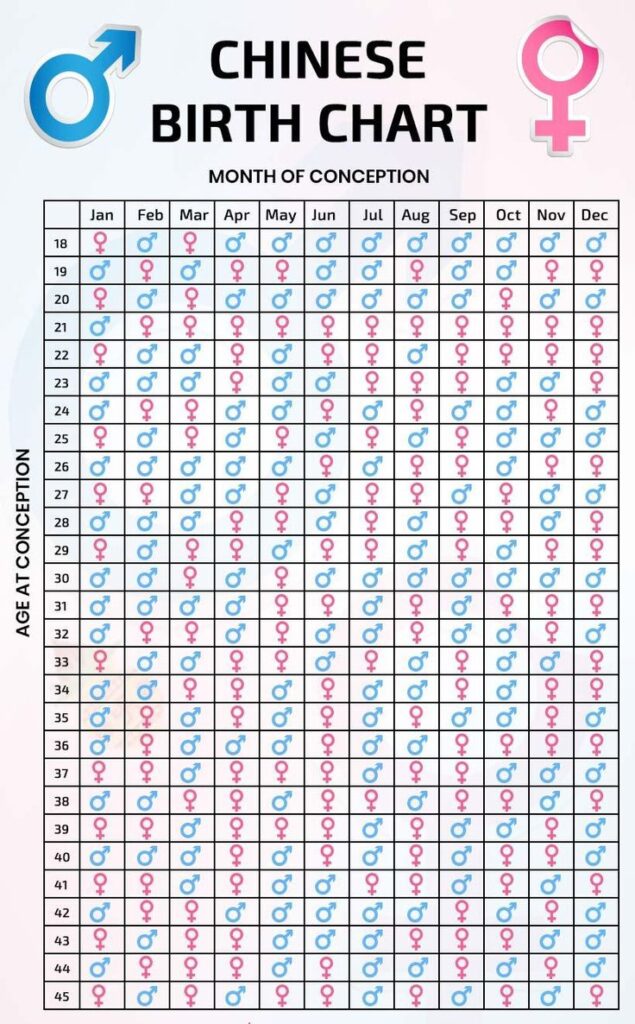
Because the boy/girl values depend on correctly converted lunar dates, the calculator above is the most reliable way to read the chart — it removes the two places people most often slip: miscounting lunar age and picking the wrong lunar month.
2026 update: Year of the Fire Horse
2026 is the Year of the Horse (属马 shǔ mǎ), and more precisely the Fire Horse (火马 huǒ mǎ) — a combination that recurs only once every 60 years. The lunar year begins at Spring Festival on February 17, 2026 and runs until February 5, 2027.
Here is the part that matters for prediction, and where a lot of online guides mislead readers: the zodiac animal does not change the chart. The Snake year, the Horse year, the element — none of it alters which cell reads boy or girl. What actually changes each year is only the calendar conversion: the Spring Festival date moves, so the boundary for adding a year to the lunar age moves with it, and the Gregorian-to-lunar month mapping shifts slightly.
What “2026” actually changes
- Lunar New Year date: February 17, 2026 — the cutoff for the lunar-age +1.
- Month conversion: Gregorian conception months map to slightly different lunar months than in 2025.
- The chart itself: unchanged. Same grid, same predictions.
Conceived in 2025, or planning for 2027? The same chart applies. The calculator handles the year-specific conversion for any year, so you don’t need a separate “2025 chart” or “2027 chart” — only the right calendar mapping, which it does for you.
How accurate is the Chinese gender calendar?
Honestly: about as accurate as a coin toss. With only two outcomes, any method lands near 50% by chance, and controlled analysis finds no reliable signal beyond that. Some sites advertise 70% or even 90% accuracy, but those figures have no scientific support.
So why do so many parents swear it worked? Two simple reasons. First, with a 50/50 base rate, it is right half the time for everyone who tries it. Second, confirmation bias: a correct guess is memorable and gets retold, while a miss is quietly forgotten. The chart’s appeal is cultural and emotional, not predictive — and that is perfectly fine if you treat it as a bit of fun.
Do not use the Chinese gender calendar for family planning or gender selection. There is no evidence it can influence or reliably predict a baby’s sex. For decisions about pregnancy, talk to a healthcare provider.
Chinese calendar vs other prediction methods
The Chinese gender calendar is one of many gender-guessing traditions. Here is how it stacks up against the popular alternatives, from folklore to medicine.
| Method | How it works | Reliability | What it’s good for |
|---|---|---|---|
| Chinese gender calendar | Mother’s lunar age × lunar conception month | ~50% (chance) | Cultural fun, baby-shower games |
| Mayan calendar | Mother’s age and conception year, odd/even rule | ~50% (chance) | Fun comparison |
| Ring / pendulum test | Swing pattern of a ring over the belly | ~50% (chance) | Party tradition |
| Ultrasound (anatomy scan) | Visual exam around 18–20 weeks | High | Confirming sex in pregnancy |
| NIPT blood test | Screens fetal DNA from a maternal blood draw | Very high, from ~10 weeks | Earliest reliable confirmation |
The takeaway: the folklore methods all hover at coin-flip odds, while an ultrasound or NIPT is the only way to actually know. Many parents enjoy the calendar precisely because it isn’t binding — a low-stakes ritual alongside real prenatal care.
Where does the Chinese gender chart come from?
The origin is more legend than documented history, and the honest answer is that no one can verify it. The most repeated story says the chart is around 700 years old and was discovered in a royal tomb near Beijing, where it was supposedly used by the imperial family to plan for male heirs. Other accounts trace it to the Qing dynasty (hence the name 清宫图 qīnggōng tú, “Qing Palace Chart”) and a document guarded by court eunuchs.
None of these tales has solid evidence behind it. What’s clear is that the chart has circulated for generations, spread worldwide in the 20th century, and remains a beloved part of pregnancy culture. Its staying power comes from meaning and ritual — a way to connect with tradition during the wait — not from any proven science. For more on the customs that surround a new arrival, see GoEast’s guide to a baby’s first month and newborn traditions in China, and the cultural backdrop of Lunar New Year and the zodiac.
Key takeaways
- The Chinese gender calendar needs just two inputs: the mother’s lunar age and lunar conception month.
- There is one authentic chart; it is the same every year — “2026” only changes the calendar conversion, not the predictions.
- 2026 is the Year of the Fire Horse, with Spring Festival on February 17, 2026.
- Accuracy is about 50% — a fun tradition, not a medical tool.
- For a confirmed result, use an ultrasound or NIPT and consult your healthcare provider.
Curious about the Chinese behind the chart?
Words like 农历 nónglì, 虚岁 xūsuì, and 属马 shǔ mǎ are everyday Mandarin. Learn to read and use them with a free trial class at GoEast Mandarin.
Frequently asked questions
Is the Chinese gender calendar accurate?
No more than chance. Studies put its accuracy around 50%, the same as flipping a coin. Claims of 70–90% accuracy have no scientific support.
Is there a different Chinese gender calendar for 2026?
No. There is one authentic chart and it never changes. A “2026” calendar simply uses the 2026 lunar conversions (Spring Festival on February 17, 2026) to translate your dates before you read the same chart.
How do I calculate my lunar age for the chart?
Take your Western age, add one because you count as age 1 at birth, and add another year if your birthday falls after Spring Festival. This traditional count is called 虚岁 xūsuì, and the calculator works it out for you.
Does the conception date use the lunar or Gregorian calendar?
The lunar calendar. Both the mother’s age and the month of conception must be converted to lunar dates, which is why an online calculator is the most reliable way to use the chart.
Does the Year of the Horse affect the prediction?
No. The zodiac animal and its element are cultural symbolism and do not change any cell on the chart. Only the calendar conversion shifts from year to year.
Can I use the Chinese gender calendar to choose my baby’s sex?
No. There is no evidence it can influence a baby’s sex, and it should not be used for family planning. Speak with a healthcare provider for medical guidance.
What is the most accurate way to know my baby’s gender?
Medical testing. A NIPT blood test can indicate sex from about 10 weeks, and an ultrasound anatomy scan confirms it around 18–20 weeks.
Is it respectful for non-Chinese parents to use the chart?
Yes, when approached with genuine cultural interest. The tradition has been shared worldwide for decades and is widely enjoyed as a fun, lighthearted custom.