Zero to HSK 3 in 7 Months: How Kathleen Learned Chinese in Shanghai
In October 2025, Kathleen moved from Canada to Shanghai with her husband and their one-year-old daughter. She was on maternity leave and did not speak any Mandarin. Seven months later she was at around HSK 3 level: chatting with strangers, ordering in restaurants and watching Chinese dramas. When she flew home, she kept going. Studying online with GoEast Mandarin from Canada, she is now working through HSK 4.

Her story answers two questions many learners quietly worry about: can you really learn Chinese in Shanghai as a beginner, and can you keep it up after you leave China?
Quick answer
A complete beginner can learn Chinese in Shanghai and keep improving online after leaving China. Kathleen, who arrived from Canada in October 2025 with no Mandarin, reached around HSK 3 level in seven months with GoEast Mandarin’s in-person intensive course (three hours of class a day) plus two private lessons a week. Back in Canada, she continued with GoEast’s online classes two to three times a week and is now working through HSK 4.

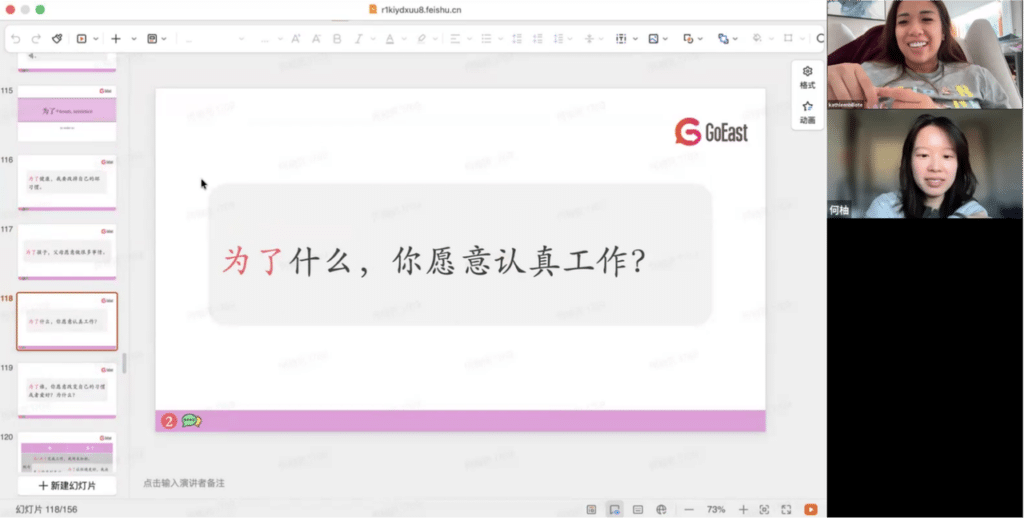
Kathleen tells her story in a 10-minute interview with GoEast Mandarin, almost entirely in Chinese (English subtitles available).
Learning Chinese in Shanghai: Kathleen’s journey at a glance
| Detail | Kathleen’s journey |
|---|---|
| Starting point | Complete beginner from Canada |
| Arrived in Shanghai | October 2025, during her maternity leave, with her husband and one-year-old daughter |
| Course in Shanghai | GoEast Mandarin’s in-person intensive group course: three hours a day, four days a week |
| Extra support | Private one-on-one lessons twice a week, plus extra private classes when Level 4 got harder |
| Level after seven months | Around HSK 3: chatting with strangers, ordering in restaurants, watching Chinese dramas |
| After leaving China | Online classes with GoEast Mandarin from Canada, two to three times a week |
| Level now | Working through HSK 4 |
Why did Kathleen choose to learn Chinese in Shanghai?
Kathleen came to Shanghai to step out of her comfort zone. She arrived during her maternity leave as a complete beginner, with two goals: learn Chinese, and give her family a completely different way of life.
She chose GoEast Mandarin for three practical reasons, the kind that matter when you are moving across the world with a baby:
- Its reputation
- Its community of students from all over the world
- Its convenient location, with two Shanghai campuses in Xuhui (the Former French Concession) and Changning
She came with almost no expectations of China, and that turned out to be part of what made it special. After traveling widely, she knows where it ranks: “China is my favorite,” she says. “I’ll miss every part of Shanghai.”
What does an intensive Chinese course in Shanghai look like?
For Kathleen, it meant three hours of group class a day in GoEast Mandarin’s in-person intensive Chinese course in Shanghai, which runs Monday to Thursday, plus private one-on-one lessons twice a week.
Her target was ambitious: to speak Chinese as fluently and naturally as a native speaker. So she treated the timetable as a starting point, not a ceiling. As she puts it:
“My goals were very high, so I pushed myself a lot. For me, three hours a day isn’t that much.”
Around her classes, and around caring for her daughter, she used every spare moment:
- Reviewing her notes
- Talking to people in Chinese whenever she could
- Watching Chinese TV
- Deliberately stepping out of her comfort zone
When the course got harder at Level 4, she added extra private classes instead of easing off.
How long did it take Kathleen to reach HSK 3?
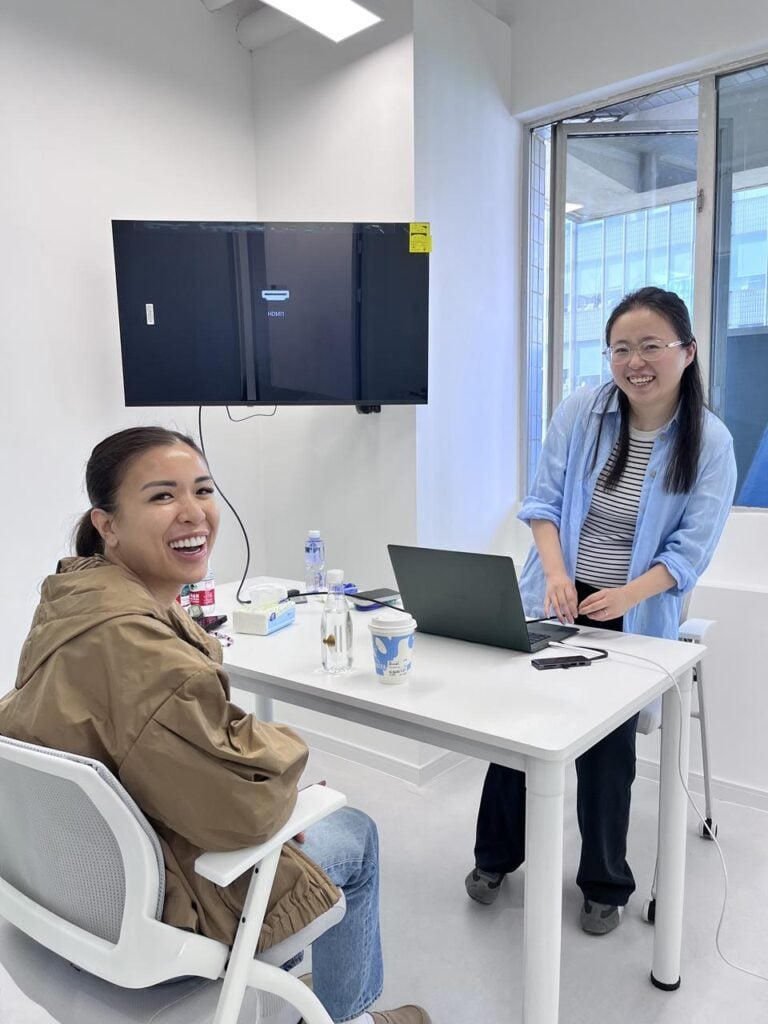
About seven months. Kathleen started from zero in October 2025 and was at around HSK 3 level seven months later, comfortable using Chinese in cafés, in restaurants and in conversations with native speakers.
Three things explain the pace:
- Volume. Three hours of group class a day, four days a week, plus two private lessons every week.
- Daily use. She practiced outside class every day, with the people around her and with Chinese TV.
- Extra help at the hard points. When Level 4 got tough, she added private classes rather than slowing down.
Her timeline is one learner’s result, not a promise. If you can study only a few hours a week, expect it to take longer; GoEast’s guide to how long it takes to learn Chinese breaks down typical timelines by level.
What did Kathleen learn about Chinese culture?
More than she expected, and mostly through the language itself. Kathleen credits immersive learning and the GoEast Mandarin textbooks with teaching her about overtime culture (加班 jiābān), dining culture, why Spring Festival (春节 Chūnjié) matters so much, and values such as harmony (和谐 héxié) and a sense of security (安全感 ānquángǎn). In her words:
“Immersive learning is the best way to learn about another culture. You learn about a culture through its language.”
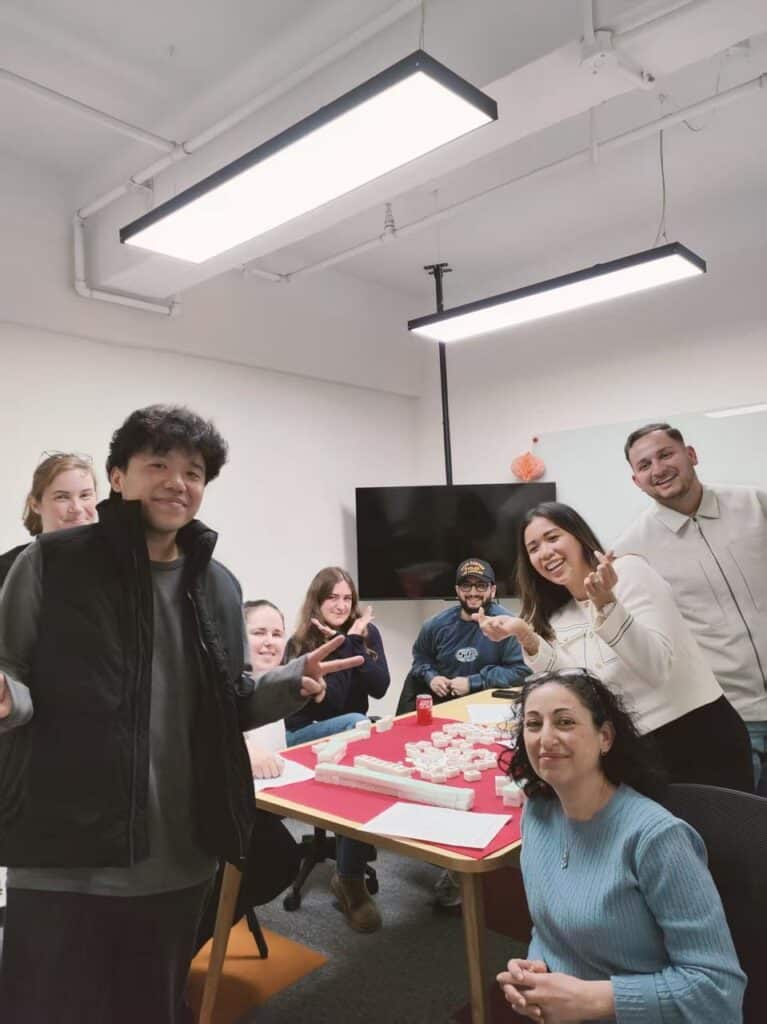
Culture also happened outside the textbook. She played mahjong (麻将 májiàng) with classmates from around the world and made zongzi (粽子 zòngzi), the sticky-rice parcels eaten at the Dragon Boat Festival, with her teachers. That is the practical side of why culture matters when you learn Chinese: the words stick when you have lived the moments they describe.
What stayed with her most was the people. “Chinese people are some of the warmest people I’ve ever met,” she says. “The more Chinese you speak, the more it opens up conversations.”
Can you keep learning Chinese online after leaving China?
Yes, and Kathleen’s progress shows how. Back in Canada, with no Chinese-speaking environment around her, she kept taking online Chinese classes with GoEast Mandarin two to three times a week. She left Shanghai at around HSK 3 and, studying online, is now working through HSK 4.
Her spoken Chinese keeps improving. Four to five months after an earlier interview in which she still relied heavily on English, she completed almost this entire interview in Chinese.
It takes discipline. She fits two to three classes a week around a busy life with a toddler, and she keeps Chinese in her day in creative ways:
- Chinese dramas. “I barely have time to sleep,” she says.
- Her own Chinese environment. “Whenever I see a Chinese person, I say, ‘Hi, are you Chinese?’ — and we start talking.”
The reaction is almost always the same. One new friend from Shanghai told her: “I thought your Chinese wasn’t that strong at first — then I realized it’s actually really good. Only seven months? That’s crazy.”
Does it matter if your Chinese teacher changes?
Not in Kathleen’s experience. When she moved online she was assigned a new teacher, and the school’s consistency made the switch a non-issue: “I feel very lucky, because all the GoEast teachers are very good.” When she hits something she doesn’t understand, usually grammar, her teacher works through it with lots of different examples until it clicks.
What advice does Kathleen give new learners?
Start, even if it is small, and don’t stop. This is what Kathleen tells anyone thinking about learning Chinese:
“Learning Chinese is a process, and it takes time. I’d recommend coming even for a few days or a week, spending a few hours a day learning Chinese — it will help you understand the culture too.”
And her last word to other learners: “Don’t give up. Keep going. You can definitely do it.”
In-person or online Chinese classes: which should you choose?
Kathleen’s journey suggests the two formats are not rivals but a sequence. In-person immersion in Shanghai built her foundation fast; online classes kept her momentum once she was home, so the progress she had worked hard for did not slip away.
| Aspect | In person in Shanghai | Online from Canada |
|---|---|---|
| Format | Intensive group course plus private lessons | Live online classes |
| Schedule | 3 hours a day, 4 days a week, plus 2 private lessons a week | 2–3 classes a week |
| Chinese around her | Everywhere: classmates, cafés, restaurants, strangers | Almost none, so she creates it: dramas and conversations with Chinese speakers |
| Her level | Zero to around HSK 3 in seven months | From around HSK 3 to working through HSK 4 |
| What it did for her | Built the foundation fast | Kept the progress from slipping away |
If you live in Shanghai but cannot commit to three hours a day, you can also learn Chinese in Shanghai part-time: GoEast’s part-time group classes meet twice a week.
Kathleen studied in two GoEast Mandarin programs: the Shanghai intensive group course and GoEast’s live online classes. GoEast Mandarin was founded in Shanghai in 2012 and teaches adults online and at its Xuhui and Changning campuses. Its classes use a flipped classroom: you study short preview videos on your own, so the entire live session goes to speaking and correction.
Key takeaways
- A complete beginner can reach around HSK 3 in seven months on an intensive schedule: Kathleen studied three hours a day in GoEast’s Shanghai intensive course, plus two private lessons a week.
- Practice outside class made the class hours count: notes, conversations and Chinese TV, fitted around childcare.
- Online classes kept her going after China: two to three a week took her from around HSK 3 into HSK 4.
- The language opened up the culture: overtime culture, dining culture, Spring Festival and values such as harmony all came through her Chinese classes.
- In-person and online work best in sequence: immersion builds the foundation fast, and online classes protect it once you are home.
Start where Kathleen started
In a free trial class you get a one-on-one lesson at your level and a learning plan built around your goals, whether you want to study in Shanghai or online.
Frequently asked questions
Can you learn Chinese in Shanghai as a complete beginner?
Yes. Kathleen arrived in Shanghai from Canada in October 2025 with no Mandarin and reached around HSK 3 level in seven months, studying in GoEast Mandarin’s in-person intensive course three hours a day with two private lessons a week.
How long does it take to reach HSK 3 from zero?
It depends mainly on how many hours you study. On an intensive schedule of three hours of class a day plus two private lessons a week, Kathleen went from zero to around HSK 3 in about seven months; part-time learners usually need longer.
How many hours a day is GoEast’s intensive Chinese course in Shanghai?
Three hours a day, four days a week (Monday to Thursday), in a morning or an afternoon session. Each course runs for four weeks.
Can you keep learning Chinese online after leaving China?
Yes. After returning to Canada, Kathleen continued with GoEast Mandarin’s live online classes two to three times a week and progressed from around HSK 3 to working through HSK 4.
Does it matter if your Chinese teacher changes when you switch to online classes?
Not in Kathleen’s experience. She was assigned a new teacher when she moved online and found the teaching just as good: “All the GoEast teachers are very good,” she says.
Where is GoEast Mandarin located in Shanghai?
GoEast Mandarin was founded in Shanghai in 2012 and has two campuses: Xuhui / Former French Concession — Room 705, Walton Plaza, 801 Changle Road; and Changning — Dingxi Road 988, South Building 801. It also teaches adults online.
Can I get a student visa to study Chinese in Shanghai?
GoEast is authorized to issue the documentation required for an X2 student visa. Requirements depend on your nationality and situation, so check the details on GoEast’s X2 student visa page.
This story is based on Kathleen’s interview with GoEast Mandarin, published as a video on GoEast Mandarin’s YouTube channel in September 2026. The quotes are her own words. For more first-hand experiences, read GoEast Mandarin student reviews.