

Directions in Chinese: Location Words and Useful Phrases
Whether you are finding a metro entrance, meeting a friend outside a restaurant, or explaining where your keys are, Mandarin uses a small set of reusable direction and location patterns. The key is to separate three ideas: where something is, which compass direction it lies in, and how someone should move.
This guide gives you the vocabulary, grammar, and street-ready phrases needed to understand and give directions in Chinese, with examples you can adapt immediately.
To describe directions in Chinese, put the reference place before the location word: 书店在学校对面 Shūdiàn zài xuéxiào duìmiàn means “The bookstore is opposite the school.” To ask the way, say 请问,地铁站怎么走? Qǐngwèn, dìtiězhàn zěnme zǒu? (“Excuse me, how do I get to the metro station?”). Common instructions combine 往 wǎng (“toward”) with a direction and 走 zǒu (“walk”), 转 zhuǎn (“turn”), or 拐 guǎi (“turn”).
What are the essential directions in Chinese?
The most useful directions in Chinese fall into three groups: relative directions such as left and right, location words such as inside and behind, and compass points. Learn the relative and location terms first because they work both indoors and on the street.
| Chinese | Pinyin | Meaning | Example location phrase |
|---|---|---|---|
| 左 | zuǒ | left | 门的左边 mén de zuǒbian — to the left of the door |
| 右 | yòu | right | 门的右边 mén de yòubian — to the right of the door |
| 上 | shàng | above; on | 桌子上 zhuōzi shang — on the table |
| 下 | xià | below; under | 桌子下面 zhuōzi xiàmian — under the table |
| 里 | lǐ | inside; in | 包里 bāo li — in the bag |
| 外 | wài | outside | 饭店外边 fàndiàn wàibian — outside the restaurant |
| 前 | qián | in front; ahead | 学校前面 xuéxiào qiánmian — in front of the school |
| 后 | hòu | behind; back | 学校后面 xuéxiào hòumian — behind the school |
| 旁边 | pángbian | beside; next to | 银行旁边 yínháng pángbian — next to the bank |
| 对面 | duìmiàn | opposite; across from | 超市对面 chāoshì duìmiàn — opposite the supermarket |
| 附近 | fùjìn | nearby; in the vicinity | 车站附近 chēzhàn fùjìn — near the station |
| 中间 | zhōngjiān | in the middle; between | 两栋楼中间 liǎng dòng lóu zhōngjiān — between two buildings |
The six core location words are 上、下、里、外、前、后 shàng, xià, lǐ, wài, qián, hòu. They attach after a reference object, so Chinese spatial phrases can feel like “table-on,” “bag-inside,” and “school-behind” to an English speaker.
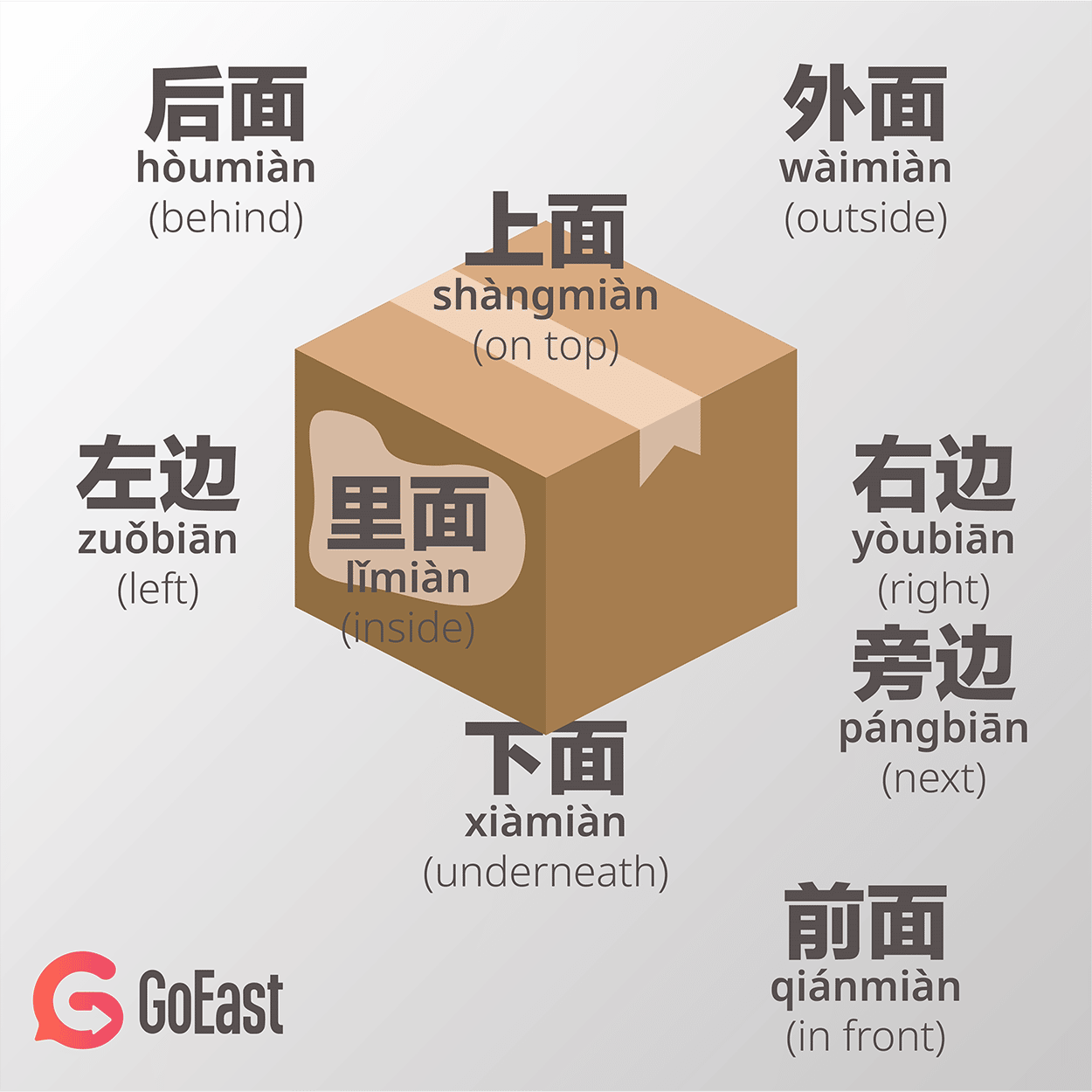
How does location grammar work in Mandarin?
The core structure for location words in Chinese is A + 在 + B + (的) + location word + (边/面). Here, A is the person or thing being located, 在 zài means “to be located at,” and B is the reference object or place.
Worked grammar example. To say “My keys are inside the box,” choose A = my keys, B = box, and the location word “inside.”
Result: 我的钥匙在盒子里面 Wǒ de yàoshi zài hézi lǐmian — literally, “my keys are located box-inside.”
The small elements in parentheses are often optional, but the location word itself is not:
- 的 de: With a simple place noun, speakers commonly omit this linking particle: 猫在桌子下面 Māo zài zhuōzi xiàmian (“The cat is under the table”). Keep it when it makes a longer relationship clearer, as in 我站在盒子的左边 Wǒ zhàn zài hézi de zuǒbian (“I am standing to the left of the box”).
- 边 bian and 面 mian: These suffixes turn a direction into a fuller location expression. For example, 前边 qiánbian and 前面 qiánmian both mean “in front.” Short forms are also common, especially 桌子上 zhuōzi shang and 包里 bāo li.
- The direction remains after B: Chinese says “school-front,” not “front-school.” The reference place is the anchor, and the location word follows it.
Pronunciation note: On their own, 边 biān and 面 miàn have full lexical tones. As suffixes in words such as 旁边 pángbian and 后面 hòumian, they are commonly pronounced with a neutral tone, so the suffix appears without a tone mark in the pinyin. Final 上 shang and 里 li can also become light or neutral in everyday speech.
How do you ask for directions in Mandarin?
The most adaptable way to ask for directions in Mandarin is 请问 + destination + 怎么走? It means “Excuse me, how do I get to [destination]?” and works even when you do not know whether the answer involves walking, turning, or taking transport.
- Get the listener’s attention politely. Begin with 请问 qǐngwèn, a polite “may I ask.”
- Name your destination. For example, use 地铁站 dìtiězhàn for “metro station” or 洗手间 xǐshǒujiān for “restroom.”
- Ask how to get there. Add 怎么走 zěnme zǒu, literally “how go.”
Useful complete questions include:
- 请问,火车站怎么走? Qǐngwèn, huǒchēzhàn zěnme zǒu? — Excuse me, how do I get to the train station?
- 请问,附近有便利店吗? Qǐngwèn, fùjìn yǒu biànlìdiàn ma? — Excuse me, is there a convenience store nearby?
- 地铁站在哪儿? Dìtiězhàn zài nǎr? — Where is the metro station?
- 离这儿远吗? Lí zhèr yuǎn ma? — Is it far from here?
If you want a dedicated travel dialogue with more ways to clarify an answer, continue with GoEast’s guide to asking for directions in Mandarin Chinese.
How do you give directions step by step?
Chinese route instructions usually combine a movement phrase with a landmark. The three building blocks are 一直走 yìzhí zǒu (“go straight”), 往 + direction (“toward + direction”), and a turn verb.
| Instruction | Meaning | When to use it |
|---|---|---|
| 一直走 Yìzhí zǒu | Go straight / keep going | Continue without turning |
| 往前走 Wǎng qián zǒu | Walk forward | Move in the direction ahead |
| 往左转 Wǎng zuǒ zhuǎn | Turn left | Take the left direction |
| 往右拐 Wǎng yòu guǎi | Turn right | Take the right direction |
| 过马路 Guò mǎlù | Cross the road | Move to the other side |
| 到路口 Dào lùkǒu | When you reach the intersection | Introduce the next step |
| 掉头 Diàotóu | Make a U-turn; turn around | Reverse direction |
A natural sequence is 一直走,到路口往左转 Yìzhí zǒu, dào lùkǒu wǎng zuǒ zhuǎn: “Go straight, and turn left when you reach the intersection.” Mandarin often leaves out a subject such as “you” in instructions because the context already makes it clear.
Add a landmark to confirm the destination: 银行就在右边 Yínháng jiù zài yòubian means “The bank is right there on the right.” The word 就 jiù adds a sense of “right there” or “then,” which reassures the listener that the place will be easy to spot.
What are the Chinese compass directions?
The four Chinese compass directions are east, west, south, and north. A familiar fixed listing is 东西南北 dōng xī nán běi (“east, west, south, north”), although maps and actual route descriptions naturally use whichever point is relevant.
| Character | Pinyin | Compass direction | Location form |
|---|---|---|---|
| 东 | dōng | east | 东边 dōngbian — the east side |
| 西 | xī | west | 西边 xībian — the west side |
| 南 | nán | south | 南边 nánbian — the south side |
| 北 | běi | north | 北边 běibian — the north side |
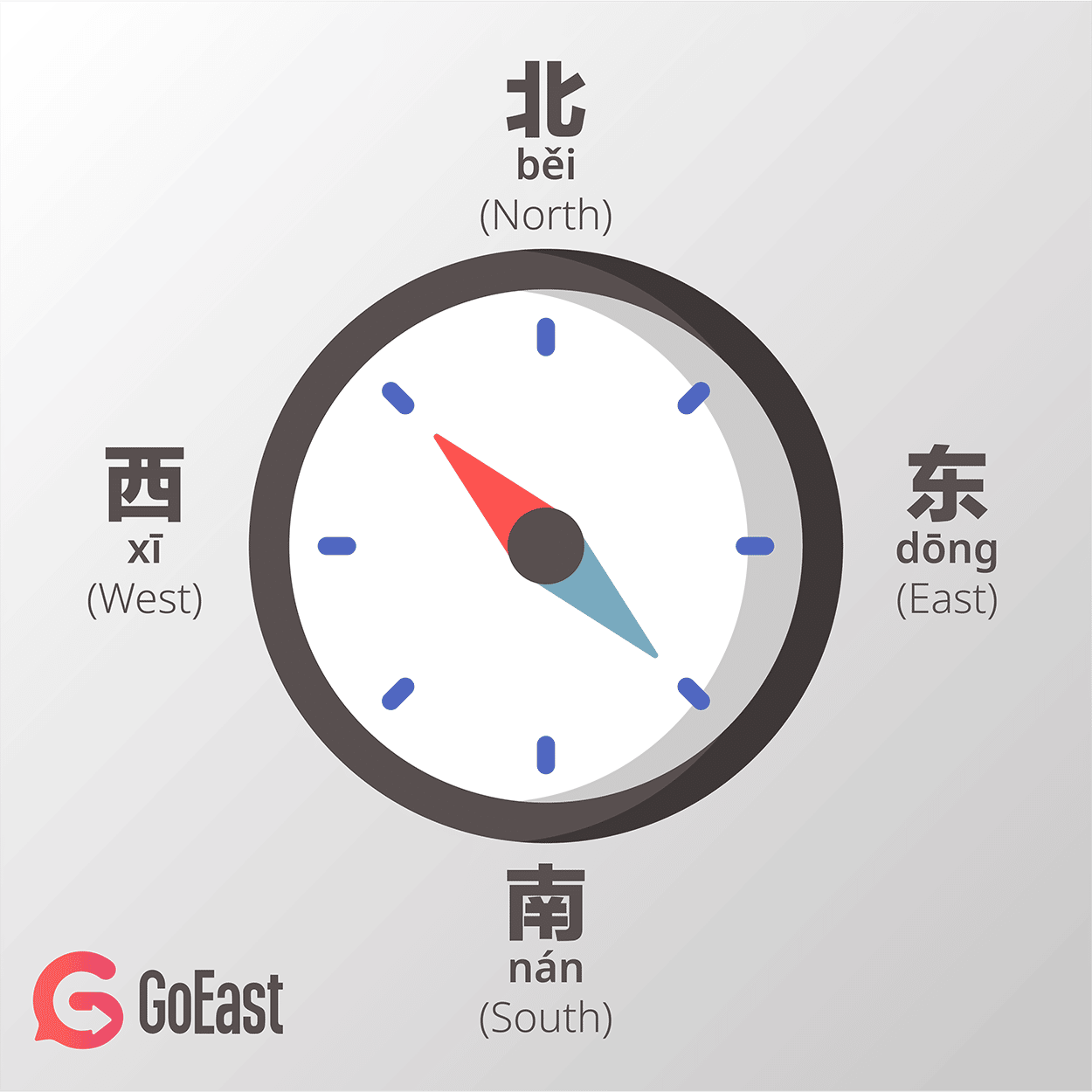
For diagonal Chinese compass directions, east or west comes first: 东北 dōngběi is northeast, 东南 dōngnán is southeast, 西北 xīběi is northwest, and 西南 xīnán is southwest. Do not translate the English word order piece by piece: “southwest” becomes 西南, not “south + west.”
Compass words can replace left and right when a route follows the street grid: 一直往北走 Yìzhí wǎng běi zǒu means “Keep going north.” Place names also preserve compass information. For example, 北京 Běijīng literally contains “northern capital,” while 南京 Nánjīng contains “southern capital.”
How are location words used in real conversations?
In conversation, the answer is often shorter than the full grammar formula. Once both speakers know which object they are locating, Mandarin can omit repeated information and answer with only 在 zài plus the location phrase.
Finding an object at home
A:我的手机在哪儿? Wǒ de shǒujī zài nǎr?
A: Where is my phone?
B:在包里。 Zài bāo li.
B: In the bag.
Meeting outside a restaurant
A:你在饭店里吗? Nǐ zài fàndiàn li ma?
A: Are you inside the restaurant?
B:不在,我在饭店外边。 Bú zài, wǒ zài fàndiàn wàibian.
B: No. I am outside the restaurant.
Checking a landmark
A:书店在学校前面吗? Shūdiàn zài xuéxiào qiánmian ma?
A: Is the bookstore in front of the school?
B:不在,在学校后面。 Bú zài, zài xuéxiào hòumian.
B: No. It is behind the school.
These exchanges show why the reference object matters. “Behind” alone is vague; “school-behind” creates a usable location. This noun-first spatial order is one of the most consistent features of directions in Mandarin.
What is the difference between 在 and 有 for location?
Use A + 在 + location when the thing is already identified and you want to say where it is. Use location + 有 + thing when you introduce the existence of something at that place.
| Pattern | What it answers | Example |
|---|---|---|
| A + 在 + location | Where is a known thing? | 书在桌子上 Shū zài zhuōzi shang — The book is on the table. |
| Location + 有 + thing | What exists there? | 桌子上有一本书 Zhuōzi shang yǒu yì běn shū — There is a book on the table. |
The second pattern uses 有 yǒu (“to have; there is/are”) as an existence verb. This is useful for asking about amenities: 这附近有药店吗? Zhè fùjìn yǒu yàodiàn ma? means “Is there a pharmacy near here?” For a deeper explanation, see GoEast’s guide to 有 in Chinese grammar.
Do people use different direction words across China?
You may hear different preferences, but they are tendencies rather than strict regional rules. As a GoEast teaching note, some speakers in northern cities readily use compass points in everyday routes, while many speakers elsewhere may favor relative terms such as left, right, front, and back. Individual habits, local street layouts, and context matter more than a simple north-versus-south rule.
The verbs 转 zhuǎn and 拐 guǎi can both describe turning. Some regional speech favors one over the other, but both 左转 zuǒ zhuǎn and 左拐 zuǒ guǎi will be understood as “turn left.” Road signs and navigation prompts commonly use 转, while conversational choices vary.
Shanghai taxi language: A traditional local distinction uses 大拐 dàguǎi (“big turn”) for a left turn and 小拐 xiǎoguǎi (“small turn”) for a right turn. The names reflect the broader arc of a left turn across the road versus the tighter arc of a right turn. This is useful cultural listening knowledge, not vocabulary you must use everywhere in China.
For reversing course, Mandarin does not describe the shape of the English letter U. It uses 掉头, literally conveying a turn of direction. You may hear 前面可以掉头 Qiánmian kěyǐ diàotóu: “You can make a U-turn ahead.”
What mistakes should learners avoid?
The two biggest mistakes come from treating 在 as if it already meant “in/on” and copying English preposition order. Fix both by remembering: reference object first, location word after it.
Do not drop the location word. 笔在包 Bǐ zài bāo is incomplete if you mean “The pen is in the bag,” because 在 only marks being located somewhere. Say 笔在包里 Bǐ zài bāo li.
- English word order: Do not say 书在上桌子 Shū zài shàng zhuōzi for “The book is on the table.” The correct order is 书在桌子上 Shū zài zhuōzi shang.
- Wrong diagonal order: Southwest is 西南, with west before south. All four diagonal compounds begin with east or west.
- Confusing position with movement: 在 locates something; 往 points movement toward a direction. Compare 银行在左边 Yínháng zài zuǒbian (“The bank is on the left”) with 往左走 Wǎng zuǒ zǒu (“Go left”).
- Overusing 的: 的 can be natural or helpful, but short everyday phrases such as 桌子上 and 学校旁边 usually do not require it.
- Forcing one suffix everywhere: 边 and 面 overlap in many basic location expressions, but fixed words and speaker preferences vary. Learn frequent chunks such as 旁边, 对面, and 附近 as complete vocabulary.
How can you build a complete route in Chinese?
Build a route one decision at a time: establish the first movement, name the turning landmark, give the turn, and finish with the destination’s position. This keeps the instruction easy to follow and easy to repeat.
Worked directions example. A visitor leaves a metro station, walks straight to an intersection, turns right, and finds a café beside a bank.
Result: 从地铁站出来以后一直走,到路口往右转。咖啡店在银行旁边。 Cóng dìtiězhàn chūlai yǐhòu yìzhí zǒu, dào lùkǒu wǎng yòu zhuǎn. Kāfēidiàn zài yínháng pángbian. — “After coming out of the metro station, go straight. Turn right at the intersection. The café is next to the bank.”
Notice the progression: 从 cóng marks the starting point, 一直走 gives continuous movement, 到 introduces the landmark where the action changes, 往右转 gives the turn, and 在银行旁边 identifies the final position. If you are at HSK 1 level, practice the shorter building blocks first; GoEast’s HSK 1 Chinese course provides a structured path through this beginner grammar and vocabulary.
Key takeaways
- Location order: Say the reference object before the location word: B + 上/下/里/外/前/后.
- Core grammar: Use A + 在 + B + (的) + location word + (边/面) to locate a known person or thing.
- Street directions: Ask 请问 + destination + 怎么走, then listen for 一直走 and 往 + direction + 转/拐.
- Compass order: Remember 东西南北, and put east or west first in diagonal compounds such as 东北 and 西南.
- Existence: Use location + 有 + object to say that something exists in or near a place.
Practice directions with a GoEast teacher
Turn these patterns into real conversation in a personalized online Mandarin trial class.
Frequently asked questions
How do you say directions in Chinese?
Directions can be 方向 fāngxiàng, while route directions or guidance can be expressed with phrases such as 请问…怎么走 (“How do I get to…?”). For practical navigation, learn 左 (“left”), 右 (“right”), 一直走 (“go straight”), and 往 + direction + 转/拐 (“turn toward…”).
How do you say north, south, east, and west in Mandarin?
North is 北 běi, south is 南 nán, east is 东 dōng, and west is 西 xī. A common fixed Chinese order is 东西南北 dōng xī nán běi: east, west, south, north.
How do you ask “How do I get there?” in Chinese?
Say 请问,怎么走? Qǐngwèn, zěnme zǒu? after naming or indicating the destination. A complete example is 请问,火车站怎么走? (“Excuse me, how do I get to the train station?”).
What is the Chinese grammar pattern for saying where something is?
Use A + 在 + B + (的) + location word + (边/面). In 猫在桌子下面 Māo zài zhuōzi xiàmian (“The cat is under the table”), the cat is A, the table is B, and 下面 supplies the precise location.
What is the difference between 旁边, 对面, and 附近?
旁边 means directly beside or next to something, 对面 means opposite or across from it, and 附近 means generally nearby. The first two describe a clearer spatial relationship; 附近 covers a less exact surrounding area.
Do 转 and 拐 both mean “turn” in Chinese?
Yes. 转 zhuǎn and 拐 guǎi can both describe a turn in route instructions, as in 左转 and 左拐 (“turn left”). Regional and personal preferences differ, while 转 is especially common in signs and navigation language.
How do you say “make a U-turn” in Mandarin?
Say 掉头 diàotóu, which means to reverse direction or make a U-turn. For example, 前面可以掉头 means “You can make a U-turn ahead.”